Tag: Debt

November 18 – November 24, 2016

Chinese mainland real estate companies pricing out local developers in Hong Kong.

Happy Thanksgiving everyone and thanks for reading.

Headlines

Special Reports / Opinion Pieces

Briefs

  • Esther Fung of the Wall Street Journal highlighted that some property landlords are making deals with Uber and Lyft to allow for or make up for parking shortages.
    • “Ride services such as Uber and Lyft, along with the promise of driverless cars, represent the ‘single biggest game-changer for real estate’ over the next several decades, said Dave Bragg, an analyst at real-estate research firm Green Street Advisors.”
    • “In all, Green Street estimates parking needs will be cut in half over the next 30 years amid an anticipated decline in vehicle ownership, eliminating the need for 75 billion square feet of parking space.”
    • “Green Street expects mass adoption to begin around 2030 and to be completed 15 years later. Uber already has suggested its entire fleet would be driverless by 2030.”
    • Are the Uber drivers savvy to this?

 Graphics

FT – Italian 10-year bonds on course for worst month since 2012 – Mehreen Khan 11/17

ft_longest-losing-streaks-for-the-euro_11-17-16

NYT – As American as Apple Pie? The Rural Vote’s Disproportionate Slice of Power – Emily Badger 11/20

nyt_rural-americas-slice-of-power_11-20-16

Visual Capitalist – How Much Government Debt Rests Upon Your Shoulders – Jeff Desjardins 11/23

visual-capitalist_government-debt-snowball_11-23-16

Featured

*Note: bold emphasis is mine, italic sections are from the articles.

Mainland money distorting Hong Kong land prices, tycoon warns. Ben Bland. Financial Times. 24 Nov. 2016.

An interesting thing when local developers are priced out of a market by aggressive and seemingly foolhardy outsiders. What’s noteworthy is who is making the statement and how much development property sites are now going for in Hong Kong – despite its troubles.

“Lui Che-woo this month lost out in an auction for a Hong Kong site that was acquired by a subsidiary of HNA, the acquisitive (Chinese) mainland conglomerate, at double the price paid for a similar site in 2014.” 

Lui Chee-woo is head of Galaxy Entertainment and happens to be worth $11bn according to Forbes. HNA is a Chinese conglomerate with business lines that include aviation (Hainan Airlines), real estate, financial services, etc.  HNA also recently acquired a 25% stake in Hilton Worldwide from Blackstone for about $6.5bn in October.

“The site went for about HK$13,500 (USD $1,740) per square foot – similar to the going rate for completed apartments nearby.” 

That’s per buildable square foot folks…add another $1,000 psf in direct construction costs (probably around that amount to attain a finish level worthy of these price points), plus another $1,000+ psf or so in soft costs (you’ll need brand name architects to be consistent with the message), financing, and profit, and you’re at around $4,000+psf.  Not unheard of in this market, but consider the comps at around 50% of this…

“Mainland developers acquired 44% of the residential land sold by the Hong Kong government last year, up from just 7% in 2012, according to calculations by Spacious, a property listings website. In the year to date, mainland companies have bought 39% of the land auctioned.” 

ft_mainland-chinese-companies-piling-into-hk_11-24-16

Bottom line, different folks/companies have different return metrics and objectives…

Other Interesting Articles

Bloomberg Businessweek

The Economist

A Wealth of Common Sense – How Bad Could Bond Market Losses Get? 11/20

Economist – You may be higher up the global wealth pyramid than you think 11/23

FT – China’s hairy crab scandal reveals depth of pollution crisis 11/17

FT – Jared Kushner, favored son-in-law of Donald Trump 11/18

FT – Blackstone looks to sell $2.3bn Japan property portfolio to Anbang 11/21

FT – Honeymoon is over for new Saudi leader as reform pain kicks in 11/22

NYT – Donald Trump’s Son-in-Law, Jared Kushner, Tests Legal Path to White House Job 11/17

NYT – Quit Social Media. Your Career May Depend on It. 11/19

NYT – Italy’s Banks Are in a Slow-Motion Crisis. And Europe May Pay. 11/19

NYT – Dallas Stares Down a Texas-Size Threat of Bankruptcy 11/20

NYT – Gender Colors Outrage Over Scandal Involving South Korea’s President 11/21

NYT – Mortgage Rates’ Rise Catches Home Buyers – and Lenders – Off Guard 11/23

WP – The North Pole is an insane 36 degrees warmer than normal as winter descends 11/17

WSJ – China Cracks Down on Home Buyers With Fake Divorces 11/22

WSJ – Rising Rates Threaten Global Property Investments 11/22

November 11 – November 17, 2016

Folks this Pension issue is a BIG PROBLEM. Speaking of problems, pollution in Delhi is a doozy. Supply side subsidies loom large in corporate China.

Headlines

Special Reports / Opinion Pieces

  • GMO Quarterly Letter – Not With a Bang But A Whimper – Jeremy Grantham – Q3 2016
    • “Well, the US market today is not a classic bubble, not even close. The market is unlikely to go “bang” in the way those (Japanese land and Japanese equities in 1989, US tech in 2000, and more or less everything in 2007) bubbles did. It is far more likely that the mean reversion will be slow and incomplete. The consequences are dismal for investors: we are likely to limp into the setting sun with very low returns. For bubble historians, though, it is heartbreaking for there will be no histrionics, no chance of being a real hero. Not this time.”

Briefs

    • While not the crux of the article, Anjani provides a succinct description of the rationale for Prime Minister Modi’s recent invalidation of 500 and 1,000-rupee notes (with just a few hours’ notice).
    • “The shock reform is aimed at rubbing out India’s pervasive black money – or unaccounted-for cash, some counterfeit, some legitimate but evading taxes. It is a bold move for Prime Minister Narendra Modi, who should get credit for bringing a larger part of the shadow economy into the formal economy.”
    • “But it is a dangerous move in the near term. The shadow economy accounts for more than 20% of gross domestic product and cash is equal to 12% of the GDP, triple the level in emerging markets generally, according to Nomura. The move has the potential to stifle commerce until the new notes are widely available.”
  • Pilita Clark of the Financial Times discussed an interesting finding by Scientists that there is progress in the fight against growing CO2 emissions.
    • “Global carbon dioxide emissions from burning fossil fuels have stayed almost flat for the third year in a row in what scientists say is a “clear and unpredicted break” that could mark a turning point in the world’s efforts to curb climate change.”
    • “Emissions are only expected to rise by 0.2% in 2016, having failed to increase in 2015 and growing by just 0.7% in 2014.”
    • “That is a sharp turnaround from the decade up to 2013 when carbon pollution growth averaged 2.3% a year.”
    • “A fall in the use of coal in China, by far the world’s largest carbon emitter, is the main reason for the slowdown.”
    • However, “researchers also cautioned that the job of curbing dangerous temperature rises had been made harder by the record growth of carbon dioxide concentrations in the atmosphere.”
    • “Atmospheric CO2 levels surged to 400 parts per million in 2015, the highest level seen in at least the last 800,000 years.”
    • “Concentrations are expected to climb to new records in 2016 on the back of a strong El Nino weather system that produced hot and dry conditions in many parts of the world, sapping the ability of trees and other vegetation to absorb carbon dioxide.”
  • Lucy Hornby and Christian Shepherd of the Financial Times featured the lengths that Chinese shopping mall landlords are going through to attract visitors to their centers, steps that include housing a polar bear named ‘Pizza.’
    • “The use of animals and other attractions comes as malls combat overcapacity, a problem immediately apparent to anyone who has turned up at a dusty, half-vacant shopping center in China’s provincial cities. The country has an estimated 4,000 malls, more than the US, and plans to reach 7,000 by 2025, according to Mall China, an industry organization.”
    • “Malls are starting to bring in a lot more entertainment and a lot more food. There is also a big focus on children – playgrounds, learning centers, even museums.” – Shaun Rein, founder of Shanghai-based China Market Research Group
    • “Last year 83 shopping malls gave up the fight and closed, according to a blue book on the commercial sector by the Chinese Academy of Social Sciences. They will be joined this year by Marks and Spencer, which announced last week it would close several stores in China in an effort to boost its flagging fortunes.”
  • Landon Thomas Jr. of the New York Times highlighted a recent interview with Blackstone’s Hamilton E. James and his plans to help with the retirement crisis.
    • The billionaire, Hamilton E. James, president of Blackstone, the private equity group. The plan, mandatory retirement contributions. It works in Singapore…
    • Why… “the average retirement savings for Americans from the age of 40 to 55 is $14,500… Sixty-eight percent of working-age Americans do not have an employer-sponsored retirement plan. And by 2050, 25 million Americans are projected to face lives of poverty when they stop working.”
  • Peter Grant of the Wall Street Journal pointed to the trouble brewing in commercial real estate.
    • “Defaults are rising in a key corner of the commercial real-estate debt market just as borrowing costs are set to jump, raising the likelihood of a slowdown of the $11 trillion U.S. commercial property sector in 2017.”
    • “Commercial property sales volume was down 8.6% in the first nine months of 2016 to $345.4 billion, according to Real Capital Analytics.”
    • “Now defaults are on the rise as well. More than 5.6% of some $390 billion worth of commercial property mortgages that have been packaged into securities was more than 60 days late in payment in September, according to Moody’s Investors Service. That was up from a 4.6% delinquency rate earlier this year.”
    • “In all, Morningstar Credit Ratings LLC predicts borrowers won’t be able to pay off roughly 40% of the commercial mortgage-backed securities loans coming due next year.”
    • “Adding to the market’s worries are new rules that go into effect on Christmas Eve under the Dodd-Frank regulatory overhaul requiring issuers of commercial mortgage-backed securities to keep at least 5% of the securities they create.”
    • “The so-called risk-retention rules likely will make borrowing more costly and complicated, raising the chances that some property owners won’t be able to refinance loans from the boom years.”
  • Chris Kirkham of the Wall Street Journal illustrated how a worker shortage has led more home builders to turn to prefab construction.
    • “A persistent shortage of construction workers across the U.S. is prompting some of the nation’s largest home builders to experiment with a model they once derided: factory production.”
    • “In the U.S., only about 2% to 3% of homes built in recent years are classified as modular, according to the Census. In other parts of the world, that share is significantly higher. More than a third of all homes in Austria and Sweden are built using off-site methods, and in Japan more than three-quarters of all detached homes are pre-assembled, according to industry research.”
    • wsj-modular-home-building_11-14-16
    • “But throughout the U.S. housing recovery, builders have suffered from a shortage of skilled labor, making it tough for them to keep up with demand. The number of workers employed in the industry this year is nearly 30% below the peak in 2006 and more than 15% below the average during the 2000s, according to the Labor Department.”
  • Chris Kirkham of the Wall Street Journal featured a recent affordable-housing initiative that was passed in Los Angeles that builders say will stifle construction.
    • “Nearly two-thirds of Los Angeles voters last week approved a citywide affordable-housing requirement for developers seeking to build projects of 10 or more units that need a zoning or height change.”
    • “The rule requires that up to 25% of units in rental properties and up to 40% in for-sale projects meet affordability guidelines. Alternatively, developers can pay a fee to the city.”
    • On top of that, the Los Angeles initiative “sets wage standards for the projects.”
    • “Developers must pay construction wages on par with those required for public-works projects, hire 30% of the workforce from within city limits, set aside 10% of jobs for certain disadvantaged workers living within 5 miles of the project and ensure 60% of workers have experience on par with graduates of a union apprenticeship program.”
    • Yeah, so that shortage in labor mentioned above is only going to get better when the qualifications and attributes of which labor you can use are made specific.
    • “Research is mixed on whether affordable housing mandates restrict the overall supply of housing in an area. A San Jose University study of California cities adopting such requirements in the mid-2000s found a notable decline in building permits after the rules were put in place, whereas other studies have found little or no effect on overall construction.”

Graphics

Bloomberg – World’s Biggest Real Estate Binge Is Coming to a City Near You 11/14

bloomberg_rising-chinese-real-estate-prices_11-14-16

FT – India’s cash clampdown is not radical enough – Martin Sandbu 11/14

ft_payment-mix-by-selected-countries_2015

FT – 10-yr Bund yields at 9-month high as bond sell-off continues – Nicholas Megaw 11/13

ft_german-10-year-debt_11-13-16

WSJ – Daily Shot Charts – 11/15

daily-shot_30yr-us-treasury-yield_11-15-16

daily-shot_5yr-us-treasury-yield_11-15-16

daily-shot_market-probability-of-2016-fed-rate-hike_11-15-16

daily-shot_global-cost-of-diabetes_11-15-16

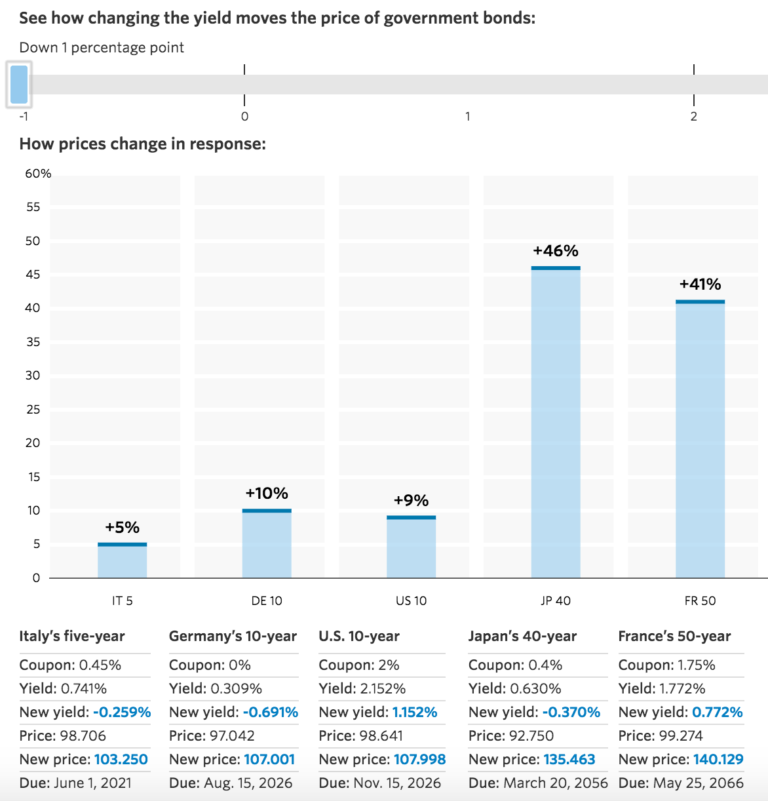
A Wealth of Common Sense – The Bright Side of Rising Interest Rates – Ben Carlson 11/13

Charts from the Wall Street Journal. Effect of a 1 percentage point increase:

wsj_effects-of-yield-change-increase-of-1-point_11-13-16

Effect of a 1 percentage point decrease:

wsj_effects-of-yield-change-decrease-of-1-point_11-13-16

Featured

*Note: bold emphasis is mine, italic sections are from the articles.

Era of Low Interest Rates Hammers Millions of Pensions Around World. Timothy W. Martin, Georgi Kantchev, and Kosaku Narioka. Wall Street Journal. 13 Nov. 2016.

“As low interest rates suppress investment gains in the pension plans, it generally means one thing: Standards of living for workers and retirees are decreasing, not increasing.”

“The low rates exacerbate cash problems already bedeviling the world’s pension funds. Decades of underfunding, benefit overpromises, government austerity measures and two recessions have left many retirement systems with deep funding holes. A wave of retirees world-wide is leaving fewer active workers left to contribute. The 60-and-older demographic is expected to roughly double between now and 2050, according to the United Nations.”

“Pension funds around the world pay benefits through a combination of investment gains and contributions from employers and workers. To ensure enough is saved, plans adopt long-term annual return assumptions to project how much of their costs will be paid from earnings. They range from as low as government bond yield in much of Europe and Asia to 8% or more in the U.S.”

“The problem is that investment-grade bonds that once churned out 7.5% a year are now barely yielding anything. Global pensions on average have roughly 30% of their money in bonds.”

“Funding gaps for the two biggest funds in Europe and the U.S. have ballooned by $300 billion since 2008, according to a Wall Street Journal analysis.”

“Japan is wrestling with the same question of generational inequality. Roughly one-quarter of its 127 million residents are now old enough to collect a pension. More than one-third will be by 2035.”

wsj_pension-pressure_11-13-16

“A typical Japanese couple who are both 65 would collect today a monthly pensions of ¥218,000 ($2,048). If they live to their early 90s, those payouts, adjusted for inflation, would drop 12% to ¥192,000.”

“In the U.S., the country’s largest public-pension plan is struggling with the same bleak outlook. The California Public Employees’ Retirement System, which handles benefits for 1.8 million members, recently posted a 0.6% return for its 2016 fiscal year, its worst annual result since the financial crisis. Its investment consultant recently estimated that annual returns will be closer to 6% over the next decade, shy of its 7.5% annual target.”

“Yet the Sacramento-based plan still has just 68% of the money needed to meet future retirement obligations. That means cash-strapped cities and counties that make annual payments to Calpers could be forced to pay more.”

As an example, the affluent city of Costa Mesa in Orange County, “has outsourced government services such as park maintenance, street sweeping and the jail, as a way to absorb higher payments to Calpers. Pension payments currently consumer about $20 million of the $100 million annual budget, but are expected to rise to $40 million in five years.”

“The outsourcing and other moves eliminated one-quarter of the city’s workers. The cost of benefits for those remaining will surge to 81 cents of every salary dollar by 2023, from 37 cents in 2013, according to city officials.

Pollution in India: Worse than Beijing. Economist. 10 Nov. 2016.

“Delhi’s annual average measure of PM2.5, a fine dust that is the most toxic component of its pollution, stands at 122 micrograms per cubic meter (μg/m3), about double Beijing’s annual average. On Diwali and ten succeeding days this year, Delhi’s air was clogged with averages of well over 500μg/m3, with peaks of up to 1,000μg/m3. The World Health Organization (WHO) says the ‘safe’ PM2.5 level is a mere 25μg/m3 over hours.”

“Edward Avol, an American scientist who has studied the effects of vehicle exhaust on children, says that Delhi’s pollution is at ‘an occupational level of exposure,’ meaning that it is as bad as that experienced by, say, miners using power tools in a closed space.”

Why… a couple of reasons. 1) The burning of rice stubble after harvest in neighboring areas – politicians are loath to make life difficult for farmers and have provided subsidies to encourage rice cultivation over other crops. 2) The diesel fuel used in India – which has also been subsidized to make it cheaper for farmers and truck drivers whose rigs and machinery run on diesel. Side effect is that diesel has been cheaper than gasoline, hence most Indians drive vehicles that run on diesel. 3) There are simply a lot of people in Delhi and the country is going through an industrialization.

As to the price being paid by the citizens… “A study published in Delhi in 2008 estimated that 40% of residents had damaged lungs. Along with a range of other ill effects from pollution, they were five times more likely to suffer from chronic lung disease than other Indians, and four times more likely to have hypertension.”

“Frighteningly, notes Mr. Avol, those results were based on levels of pollution that are only one-fifth to one-tenth of what Delhi lives with.”

In Trump’s China, Industrial Subsidies Loom Large. Anjani Trivedi. Wall Street Journal. 16 Nov. 2016.

“Large government subsidies, which are no secret, are becoming a larger part of operating profits at China’s companies, both state-owned and private. Almost 14% of listed, nonfinancial companies’ profits are attributable to government support, according to an analysis by Wind Info. That’s up from just under 5% six years ago. Even among private firms, many of which have state shareholders, 11% of profits come from the state.”

“Driving the need for the hand outs: In China, when a company posts losses for four straight years, it gets delisted from the stock exchange. Almost 10% of listed provincial state-owned companies rely on government largess to be profitable.”

wsj-chinese-industrial-subsidies_11-16-16

“Thriving sectors benefit as well. In China’s car industry, the world’s largest, subsidies have grown 50% annually since 2010. For leading car maker Geely, government subsidies and grants have accounted for 19% of gross profits, on average, over the past five years.”

However, “government incentives are hardly confined to China. The U.S. has its own web of tax incentives and other inducements. Global multinationals rank among the largest recipients too. Many boost come through programs that incentivize consumers. China’s help tends to be more on the supply-side.”

Other Interesting Articles

Bloomberg Businessweek

The Economist

Bloomberg – Manhattan Renters Score Record Incentives in Apartment Glut 11/10

Bloomberg – Oil, Earthquakes and the Rush to Save Oklahoma 11/14

Bloomberg – The Real Cost of an MBA 11/16

FT – India’s cash chaos sparks growing backlash 11/13

FT – Buy dollars is the sudden Trump-era consensus trade 11/13

FT – Oil demand will grow for decades, says IEA 11/15

FT – Inflating inflation expectations 11/16

FT – Italy’s 50-year bond burnt in global sell-off 11/16

FT – Bank of Japan tests new firepower 11/16

FT – China’s renminbi hits 8-year low 11/16

FT – US urged to ban acquisitions by Chinese state-owned companies 11/16

LinkedIn – Reflections on the Trump Presidency, One Week after the Election (Ray Dalio) 11/15

NYT – ‘We Couldn’t Believe Our Eyes’: A Lost World of Shipwrecks Is Found 11/11

NYT – Teslas in the Trailer Park: A California City Faces Its Housing Squeeze 11/13

WSJ – SolarCity Could Give Tesla Too Much Sun 11/13

WSJ – At Long Last: The Earnings Recession Is Finally Over 11/13

WSJ – China’s Jack of All Trades (Evergrande Group) Needs a New Strategy 11/15

WSJ – China’s Debt Plan Feels Like Bad Case of déjà vu 11/15

WSJ – Donald Trump: The Housing Market’s Latest Threat 11/15

WSJ – New Competition for ‘Co-Working’ Model 11/15

WSJ – Firms Flee Mortgage-Backed Bond Business 11/15

WSJ – Ritzy Rentals Flood the Market 11/16

WSJ – Bank of Japan Keeps Rates Ready for Something Bigger 11/17


September 30 – October 6, 2016

Xi Jinping, the master politician. In the US oil and gas industry it’s about time for some more culling of the herd. Uber providing transportation solutions for US municipalities.

Headlines

Briefs

    • “Saudi Arabia has cut public sector bonuses and benefits for the first time since the collapse in oil prices, in a move that underlines the depth of the fiscal crisis facing the kingdom.”
    • “The new rules, which come into force next month, apply to all public sector workers, both Saudis and expats, as well as the military (except soldiers serving in Yemen).”
    • “If you were a white kid who went to work straight out of high school around 1975, you earned roughly $44,000 two decades later. BY 2014, on average, your pay had fallen to $32,000 a stunning 27% decline in real terms, after accounting for inflation.”
    • “College grads are doing okay. Across all age groups, income in this group rose from $77,209 in 1996 to $94,601 in 2014, a 22.5% increase. A college-educated worker who was 28 in 1996 and 46 in 2014 enjoyed a whopping 132.8% spike in pay. The only losers among college grads were those were those 57 or older in 2014. Their pay fell from somewhere between 13% and 28.5% between 1996 and 2014, but still leveled out at $83,000 or higher in 2014, well above the national average.”
    • Yahoo Finance_Wage and salary income chart_10-5-16
  • In a Financial Times guest correspondence piece, Steven Major (head of fixed-income research at HSBC) discussed why there is no game-changer that will end the bond bull market.
    • I’m going to keep this one real brief by just listing the major points.
    • “Backdrop favors a low real natural rate of interest”
    • “Deleveraging across public and private sectors has not started”
    • “Central banks continue to amass huge balance sheets”
    • “Connectivity between markets is increasing”
    • “We realize that all this makes pretty grim reading for those hoping for an improvement in the growth outlook and a return to ‘normal,’ whatever that is. But this is part of the problem. There is no shortage of hope that something will turn up and there is excessive vested interest in the higher yield view. Too much money is chasing too little return.”
  • The Financial Times Confidential Research division produced a report on how underground loans in China are defeating attempts to cool the housing market.
    • “Analysis by FT Confidential Research suggests that underground lenders have become an important source of funding for Chinese consumers struggling to make down payments on home purchases as real estate prices surge. Such lending may hamper attempts to cool down overheating top-tier housing markets.”
    • FT_Consumer loans from underground lenders in China_10-5-16
    • “Despite concerns at the central level about housing bubbles, the property market’s rising tide is lifting other economic boats, FTCR data show. Our proprietary surveys found positive sentiment in the freight sector and construction labor market, the indices for both of which hit 2016 highs, while households have not been in such good cheer for nearly two years.”
    • FT_Average house prices in Shanghai and Shenzhen_10-5-16
    • “Consumers appear to be responding to the wealth effect generated by rising house prices. Our monthly measure of consumer sentiment rose to its highest level since October 2014. Survey respondents reported strong improvements in their household financial situations, discretionary spending and views on the economy. Furthermore, the forward-looking components of our suite of monthly data suggest momentum is set to carry through to the end of 2016.”

Special Reports / Opinion Pieces

Graphics

FT – Global economic growth ‘sliding back into the morass’ – Chris Giles 10/2

FT_Overall growth index_10-2-16

WSJ – A New Worry for Banks and the Economy – Aaron Back 10/3

wsj_growth-in-us-commercial-and-industrial-loans_10-3-16

Visual Capitalist – Black Swans: 9 Recent Events That Changed Finance Forever – Jeff Desjardins 10/5

Visual Capitalist_Black Swans_10-5-16

WSJ – Some Big U.S. Cities See Apartment Rents Fall for First Time in Years – Laura Kusisto 10/4

WSJ_Rental rates cooling off_10-4-16

FT – Perth’s slide highlights Australia commodity bust – Jamie Smyth 10/4

FT_Australian House price changes_10-4-16

FT – World debt hits $152tn record, says IMF – Claire Jones 10/5

FT_Global gross debt_10-5-16

Featured

*Note: bold emphasis is mine, italic sections are from the articles.

Xi Jinping May Delay Picking China’s Next Leader, Stoking Speculation. Chris Buckley. New York Times. 4 Oct. 2016.

“The Chinese president, Xi Jinping, appears prepared to defy the Communist Party’s established script for transferring power and delay the designation of his successor until after a party congress next year, unsettling the party elite and stirring speculation that he wants to prolong his tenure.”

“The delay would buy Mr. Xi more time to promote and test favored candidates and prevent his influence from ebbing away to a leader-in-waiting, experts and political insiders said. But the price could be years of friction while a pack of aspiring cadres vie for the top job, as well as unnerving uncertainty over whether Mr. Xi wants to stay in power beyond the usual two terms as party leader.”

“The drama will probably begin in earnest this month, when the Central Committee, about 200 senior officials who sign off on major decisions, meets in Beijing. That meeting is likely to set in motion plans for the congress, which will meet in late 2017 to endorse a new top lineup.”

“While it is a given that the congress will back Mr. Xi for another five-year term as party leader, nearly everything else is up for grabs, giving Mr. Xi great sway to shape the new leadership.”

“Five of the seven members of the powerful Politburo Standing Committee must step down because of age, assuming the informal retirement age of 68 holds. That leaves only Mr. Xi, 63, and Mr. Li, 61, to return.”

US oil and gas pipeline industry ripe for consolidation. Ed Crooks. Financial Times. 4 Oct. 2016.

“Tim Schneider, analyst at Evercore ISI, argues that the North American pipeline industry is on the verge of a wave of consolidation like the one that swept through the large integrated oil companies in the late 1990s and early 2000s.”

“The US has about 140 Master Limited Partnerships: a tax-advantaged structure available to energy infrastructure businesses that is typically used by midstream operators. Mr. Schneider argues that only about half of those have a ‘right’ to exists. Many will have to sell themselves, dispose of assets to stay alive, or ‘simply disappear’, he says.”

FT_North American pipeline M&A_10-4-16

“In 2014, there were 9,679 miles of crude oil pipeline completed in the US, according to IHS Markit, the research group. In 2017, it expects 4,175 miles of large projects to be completed, assuming Dakota Access (the contested 1,172 mile pipeline from the shale oilfields of North Dakota to Patoka, Illinois) goes ahead.”

FT_US crude oil pipeline additions_10-4-16

“Many MLPs, and some of the pipeline companies that are structured as regular corporations, have business models that depend on perpetual growth justifying continuing cash inflows.”

“Energy Transfer Partners, for example, in the first half of this year distributed $1.8bn to investors and spent $3.5bn on capital investment, but generated cash from operations of just $1.4bn. The numbers were made to add up by selling the Sunoco retail business to its affiliate Sunoco LP for $2.2bn, and by issuing units worth $1.1bn.”

In regard to the MLP industry, Tim Schneider put it this way “they are like cattle feeding at a trough. The weaker ones are going to get shoved aside.”

Uber offers subsidized rides in drive to solve US parking crisis. Leslie Hook. Financial Times. 5 Oct. 2016.

“In a first-of-its-kind of deal for Uber, Summit (New Jersey) has hired the company to provide free rides for commuters to and from its train station, starting this week. For the local authority, the six-month pilot helps solve its downtown parking crisis; for Uber, the deal is one it hopes to replicate across the country.”

“These transit deals could potentially give Uber access to a new revenue source, from transportation authorities, and access to new passengers. Just as importantly, Uber sees them as a means towards its ultimate goal: a world where shared autonomous cars are a primary mode of transportation and private vehicle ownership is no longer necessary.”

“The Summit deal focuses on what is known as the ‘last mile’ problem of getting commuters to and from rail stations, which researchers consider to be an ideal use case for ride-sharing.”

“Facing budget pressures, US cities are increasingly experimenting to see whether hiring Uber, or its smaller rival Lyft, can be a cheaper alternative to building parking garages or adding bus routes.”

“Last month, Boston announced a test program that subsidizes Uber and Lyft rides for disabled passengers, a faster option compared with the city’s door-to-door van service. Earlier this year, a county in Florida started providing free Uber rides at night for low-income passengers – a cheaper alternative to a night bus. Another city in Florida pays for all its residents to have discounted Uber rides, and Washington DC is even considering using Uber to help respond to non-emergency 911 calls.”

“In Summitt, Mayor Nora Radest said the city contacted Uber a year ago to talk about a deal because it was looking for an economical way to address its downtown parking shortage. Hiring Ubers for its commuters will cost about $167,000 a year, the city estimates, while building a parking garage would have cost more than $15m.”

“We are looking at this not as a transportation solution but as a parking solution. The goal is to get those 100 cars that sit in the commuter station all day, and get them out of there.” – Mayor Radest

Other Interesting Articles

Bloomberg Businessweek

The Economist

A Wealth of Common Sense – How Things Have Changed on Wall Street in the Last 50 Years 10/5

FT – Traditional banking is on borrowed time – so why invest? 9/29

FT – Yet more low but stable global economic growth is unsustainable (Mohamed El-Erain) 9/29

FT – China entertainment: Wanda-lust 9/30

FT – Mongolia request IMF loan 9/30

FT – Deutsche reawakens systemic fears amid talk of ‘Lehman moment’ 10/3

FT – IMF lowers growth forecast for US and other advanced economies 10/4

FT – Markets eye the taper but fear the tantrum 10/5

FT – Swiss suspect Ponzi scheme used to conceal 1MDB losses 10/5

FT – US banks roll out callable bonds to meet Fed debt rules 10/5

NYT – Developer That “Cracked the Code’ on Modular Building Exits the Business 10/5

NYT – Oil Glut? Here Comes Some More! 10/5


August 26 – September 1, 2016

A novel way of paying off debt – issue more of it, the savings are already accruing. It’s official, Nigeria is in a recession.

Headlines

Briefs

    • “Stock valuations rise and fall, but when an important factor driving market performance is mathematically unsustainable, it is worth a closer look.” Specifically corporate dividends.
    • “Aswath Damodaran, a professor at New York University’s Stern School of Business, sees this as the market’s biggest risk. Mr. Damodaran, who is considered an authority on valuation, says S&P 500 companies through the first two quarters of the year collectively returned 112% of their earnings through buybacks and dividends. That is the highest since 2008 and well above the 82% average over the past 15 years, he said in a blog post last week.”
    • “Mr. Damodaran, who likes to be provocative, says with rates this low, traditional valuation metrics are distorted. Instead, the inability of companies to keep paying off their investors will cause the next downturn. ‘This is the weakest link in this market,’ Mr. Damodaran said in an interview. ‘We know cash flows will go down. What we don’t know is what the market is pricing in.'”
    • WSJ_S&P 500 corporate dividends_8-28-16
    • “The rise of third-party mobile payments in China at the expense of credit and debit cards is threatening commercial banks’ access to the customer data viewed as crucial to newly emerging financial and consumer business models.”
    • Further UnionPay, the state-owned settlement network, and other rank and file banks are missing out on the merchant fees that these third-party platforms are redirecting.
    • “The move by more Chinese consumers to switch from swiping plastic cards to scanning QR codes with mobile wallet apps knocked $20bn from banks’ fee income in 2015, according to Kapronasia, a Shanghai-based fintech consultancy.”
    • While the fees hurt, the key is that third-party payment providers are “depriving lenders of valuable data on consumption patterns.”
    • FT_China payments moving online_8-28-16
    • China’s big-state lenders are making a shift in their lending portfolios from commercial loans to property.  “China Construction Bank (CCB) this week reported residential mortgage lending rose almost 30% in the first half of this year compared with the same period last year. Meanwhile corporate lending fell 2%. At Bank of China, mortgages rose by more than a quarter.”
    • “On the face of it, banks are moving away from risky lending. That helps their capital cushions because for every loan extended to a company, banks assign a 100% risk-weight. For residential mortgages, banks only have to set aside half that.”
    • Of course, it helps that residential prices are rising; however, “lending into the property market would make more sense if the mortgage loans weren’t going bad so fast. At CCB, while mortgage nonperforming loans accounted for only 6% of total NPLs, they rose 67% on the year compared with 26% for all loans. And that’s with prices rising nationally, and rising sharply in the biggest cities.”
  • Leo Lewis and Lucy Colback of the Financial Times covered an interesting development in how the Bank of Japan is distorting the Japanese stock indices through their massive fund flows.
    • “From July 29, when the Bank of Japan said it would nearly double its annual purchases of exchange traded funds from ¥3.3tn ($32bn) to ¥6tn, brokers in Tokyo have been selling stocks with a simple, unsettling message.”
    • “In an equity market where the central bank is the biggest whale, and where the government in various forms has become the biggest shareholder in a quarter of First Section Tokyo stocks, it’s time to buy the fund flows, not the fundamentals.”
    • FT_Stocks with highest indirect ownership by BoJ_8-30-16
    • “Goldman Sachs estimates that the doubling in BoJ buying coupled with the skew towards Nikkei weighting means that the central bank will own at least one-tenth of the equity in 32 companies by this time next year, up from five currently.”
    • “The BoJ, according to its current schedule, must buy an average of ¥70bn worth of ETFs every three trading days throughout the year.”
    • Helicopter money…

Special Reports / Opinion Pieces

Graphics

FT – Puerto Rico: An island’s exodus –  Eric Platt 8/25

FT_Puerto Rico's exodus_8-25-16

Visual Capitalist – Which Countries Are Damaged Most by Low Oil Prices? – Jeff Desjardins 8/26

Visual Capitalist_Which countries hurt the most by low oil prices_8-26-16

WSJ – Food Price Deflation Cheers Consumers, Hurts Farmers, Grocers and Restaurants 8/29

WSJ_Food price deflation_8-29-16

WSJ – China’s Private Investment Crash May Be Mirage, but Pain Is Still Real 8/28

WSJ_China fixed-asset investment_8-28-16

Visual Capitalist – Do Newly Built Skyscrapers Signal The Top of the Stock Market? – Jeff Desjardins 8/29

Visual Capitalist_Skyscraper curse_8-29-16

Featured

*Note: bold emphasis is mine, italic sections are from the articles.

Falling bond yields save taxpayers $500bn. Eric Platt. Financial Times. 31 Aug. 2016.

“The collapse in sovereign bond yields has saved taxpayers more than $500bn in annual interest expenses, allowing countries to rein in budget deficits and continue government-backed programs that would have otherwise been shelved, according to a new report.”

As of the end of last week there was $13.2tn of debt with negative yields.

“Japan, France, Germany and Switzerland are now paid to issue short-dated sovereign bonds.”

“Benefits have effectively been transferred from global investors to sovereign issuers, as sovereign borrowing costs have dropped. Should rates remain low for an extended period, it would likely erode earnings power for many large investment institutions and pension funds.” – Robert Grossman, analyst with Fitch, a rating agency

The median 10-year government bond now yields 1.17%, down from 3.87% five years ago. Japan has saved more than $95bn a year as a result of the decline in rates, while the US, UK and Germany collectively pay $104bn less annually, the study estimates.”

“Central banks have cut interest rates more than 670 times since Lehman Brothers filed for bankruptcy in 2008, or roughly one reduction every three trading days of the year, according to JPMorgan.”

FT_Central bank stimulus weighs on sovereign bond yields_8-31-16

Nigeria falls into recession as economy shrinks in second quarter. Maggie Fick. Financial Times. 31 Aug. 2016.

Nigeria has slipped into recession for the first time in more than two decades as growth in Africa’s top oil producer shrank for the second consecutive quarter.”

“The economy contracted 2.1% in the three months to the end of June, worse than analysts expected, while inflation hit a 11-year high of 17.1%, underlining the depth of the west African nation’s crisis.”

“Nigeria, which depends on petrodollars for 70% of state revenues and 90% of export earnings, has been battered by the slump in oil prices. The economy shrank 0.4% in the first three months of the year and the International Monetary Fund is forecasting that growth in 2016 will contract 1.8%.”

“The central bank increased the main interest rate by 200 basis points last month in an attempt to combat inflation, but it rose for the ninth consecutive month in July.”

“The continent’s most populous nation was one of the world’s fastest growing economies during the oil boom, but Mr. Buhari (President Muhammadu Buhari) said this month that Nigeria ‘suddenly appears to be a poor country.'”

FT_Nigeria GDP growth_8-31-16

It’s currency is having difficulties as well, “in the official market, the naira is trading below N300 to the dollar, having lost more than 40% of its value since its peg was lifted in June (to ease the country’s quickly depleting reserves of hard currency), but on the black market the currency is far weaker – it has been trading at below N400 to the dollar this week.”

FT_Nigerian Naira currency to the USD_8-31-16

Other Interesting Articles

Bloomberg Businessweek

The Economist

Bloomberg – J.C. Penny Aims to Be King of the Mall as Rivals Retreat 8/25

CoStar – Disparity in Mall Values Driven by Powerful Combination of Forces 8/31

Economist – Grim employment prospects for young people around the world 8/26

FT – How the super-rich are making their homes ‘invisible’ 8/24

FT – Chinese banks braced over industrial restructuring 8/28

FT – Mexico spends $1bn to lock in oil export prices for 2017 8/29

FT – Apple’s EU tax dispute explained 8/29

FT – DBS sells $750m in cocos at record-low yield 8/30

FT – Chinese future looms for Hong Kong’s real estate sector 8/30

FT – China turns away from the market 8/31

Inhabitat – The world’s tallest timber building was just topped off ahead of schedule 8/26

National Real Estate Investor – 2016 Could Signal a Cyclical Peak in Commercial Construction 8/25

NYT – Today’s Inequality Could Easily Become Tomorrow’s Catastrophe 8/26

NYT – Crackdown on For-Profit Colleges May Free Students and Trap Taxpayers 8/28

Zero Hedge – “I’ve Never Seen Anything Like This Before” – The Housing Markets In The Hamptons, Aspen And Miami Are All Crashing 8/28

WSJ – Which State Is a Big Renewable Energy Pioneer? Texas 8/29

WSJ – Housing Market: Why Millennials Are Getting Priced Out 8/29

WSJ – What Happens When a Central Bank Buys Property Stocks 8/30

WSJ – Shopping Malls’ New Product: Fun 8/30

WSJ – Chinese Cash Pours Into U.S. Real Estate 8/30

WSJ – Emerging Markets: Catch the Yield Where You Can 8/31

WSJ – Birth of the Index Mutual Fund: ‘Bogle’s Folly’ Turns 40 8/31


July 29 – August 4, 2016

Insurers having to rethink their business model. India makes a giant leap forward in tax reform.

Headlines

Briefs

    • “Sovereign wealth funds are investing less money directly than at any time in the past five years. This marks the end of a safety net whereby state-backed vehicles mopped up assets in times of market stress, according to research.”
    • “The Bocconi report found that state funds invested 48bn directly last year, down 57% from 112bn in 2008.”
    • “Given the low oil-price environment and lower revenues for oil producers, [state funds] no longer have the cash positions to get into the markets once they correct.” – Sven Behrendt, managing director of GeoEconomica, a consultancy
    • “What if all Londoners, no matter how young or frail, smoked for at least six years? In effect, they already do. The city’s air pollution exacts an equivalent toll on each resident, cutting short the lives of nearly 10,000 people each year and damaging the lungs, hearts and brains of children.”
    • Bottom line, more needs to be done to track and publish long-term air-quality indexes similar to the existing short-term gauges that people and cities can utilize to alter behaviors and make informed life choices.
  • Jonathan Wheatley of the Financial Times called attention to the demand that Emerging Market bonds have seen as the world has become devoid of ‘safe’ income yielding products.
    • “With an estimated 30% of global government debt now offering yields of less than zero, he (Daniel Senecal, head of credit research at Newfleet Asset Management) says traditionally conservative investors are being pushed into new areas.”
    • “If you’re a pensions guy you have to do something. With German 10-years at zero, you need to change your mindset. Your whole view migrates into US high-yield and EMs.” – Daniel Senecal
    • Geez it’s a tough world to invest in right now…

Special Reports

Graphics

WSJ – Why Bank of Japan Dipped Into Bag of Small Tricks 7/29

WSJ_Why Bank of Japan Dipped Into Bag of Small Tricks_7-29-16

Visual Capitalist – The Rise and Fall of Yahoo 7/29

Visual Capitalist_The rise and fall of Yahoo_7-29-16

Economist – Comparing urban air pollution 8/1

Economist_Nitrogen dioxide city comparison_8-1-16

FT – Japan launches $45bn stimulus package – Robin Harding 8/2

FT_Japan stimulus_8-2-16

FT – Emerging market bonds lure investors seeking yield – Jonathan Wheatley 8/2

FT_EM sovereign rally_8-2-16

WSJ – Bank of England Cuts Key Interest Rate to New Low 8/4

WSJ_Bank of England rate reaction_8-4-16

Featured

*Note: bold emphasis is mine, italic sections are from the articles.

Insurers: Forced to dig deep. Oliver Ralph and Alistair Gray. Financial Times. 1 Aug. 2016.

“Insurers globally are having to come to terms with the idea of ‘lower for longer’ interest rates, making deep changes to business models that had been unaltered for decades. Whereas previously they might have clung to the hope that higher rates were around the corner, there is a realization that the industry has to do things differently – from investing in assets that might once have been seen as too risky, to experimenting with new products.”

As to how much cash are we talking about, PwC estimates that by 2020, insurance companies will manage about $35tn worth of assets.

“Traditionally, much of that has gone to relatively safe homes, such as bonds. At the end of last year, bonds made up about 68% of US property insurers’ total investments and 76% of life insurers’, according to S&P Global Market Intelligence. When those bonds offered decent yields there was no problem. Insurers could fulfill promises to customers and still have plenty left for shareholders.”

But “by last year the net yield on US life insurers’ overall invested assets had fallen to 4.7% – about a quarter lower than 2002 levels.”

Hence, the performance of US life insurance companies has tended to move in tandem with the 10-year Treasury yield…

FT_US life insurance companies and bond yields_8-1-16

In regard to attaining higher returns, insurers can either take on higher risks or tie up cash for longer.  “Many prefer the latter, investing in more illiquid assets such as property. UK insurer Aviva says 80% of the new investments it is making to back its annuity business will be in long-duration assets rather than traditional gilts or corporate bonds.”

“Infrastructure investments are particularly popular as they offer the long-term cash flows life insurers need to back their promises. Germany’s Allianz, for example, is one of the main backers of London’s £4.2bn supersewer.”

Consider the alternative…“Nobody likes to invest at negative yields but life insurers have so much cash that they need to invest, and they need to do something with it.” – James Peagam, head of global insurance solutions at JPMorgan Asset Management

As to the other side of the equation, ‘new products’ or raising premiums, this is already underway.

“Life assurance customers may see the biggest changes. For decades, the industry has offered savings and retirement products that offer guaranteed minimum returns. In the future, these may no longer be on offer.”

“This would be a major shift. In the US, products with guarantees account for 60-80% of the US life insurers’ balance sheets, Moody’s estimates. The average outstanding guarantee is returning between 2% and 4%.”

The replacement product: “unit-linked products. These make no promises: customers’ investments simply rise and fall with the markets. They are similar to traditional asset management products.”

Which of course puts them in direct competition with traditional asset managers that are facing a major business model challenge from low-cost index fund companies like Vanguard and BlackRock.

“As Jon Hocking, an analyst at Morgan Stanley, points out, the unit-linked model distances insurers from their customers. ‘The risk is that you open Pandora’s box and the industry loses its dominant position in the long term savings market. The customer chooses between products and the only distinction is the fund performance” and fees…

So which insurers are under particular pressure, in the US these are the companies specializing in long-term care (“low interest rates have exacerbated the problems caused by rising treatment costs”) and those that have sold ‘universal life’ protection (“policies that combine death benefits with tax-advantaged savings”).

“Transamerica, a large US provider, is being sued by the advocacy group Consumer Watchdog on behalf of policyholders who bought coverage decades ago. It said consumers who had been offered guaranteed interest of at least 5.5% a year had been stung by premium increases of almost 40%.”

India’s economy: One nation, one tax. Economist. 4 Aug. 2016.

India just passed a new goods-and-services tax (GST) that will “unify the country’s 29 states and 1.3 billion people into a common market for the first time.”

“Few countries are fiddlier than India when it comes to paying taxes; the World Bank ranks it 157th out of 189 for simplicity… Because the rates differ between states, making stuff in one and selling it in another is often harder within India than it is in trade blocs such as NAFTA or the European Union.”

“That should change with the GST, essentially an agreement among all states to charge the same (still to be decided) indirect tax rates.”

“Better yet, the GST will be due on the basis of value added. That avoids businesses being thwacked by taxes on the entire value of the products they buy and sell rather than the value they create – a situation that often made it cheaper to import stuff rather than make it locally. Just as importantly, by requiring businesses to document the prices at which they buy inputs and sell products, it will force vast swathes of the economy into the reach of the taxman.”

The tax is supposed to be enacted in April 2017. There is a lot to be buttoned up by then and chances that exceptions will be inserted; however, it is good step forward and has the chance of boosting India’s GDP by 1-2 percentage points.

Other Interesting Articles

The Economist

Bloomberg – Rich Investors Fear Fortunes Will Fade While They’re Playing Golf 7/28

Bloomberg – Fragile U.S. Economy Now Facing a Slowdown in Building Boom 7/31

Bloomberg – Allianz Buys Stake in Manhattan’s 10 Hudson Yards Skyscraper 8/1

Bloomberg – Where First-Time Homebuyers Can Go Big 8/2

Fast Co. Design – An Exclusive Look At Airbnb’s First Foray Into Urban Planning 8/2

FT – The US student debt bubble is a study in financial dysfunction 7/29

FT – Ant’s Alipay challenges China Unionpay’s dominance 7/31

FT – US $18bn credit card debt spree sparks fears 7/31

FT – WTI closes in bear market 8/1

FT – Microsoft sells $20bn of debt to fund LinkedIn Deal 8/2

FT – European bank shares fall in brutal start to August 8/2

FT – Star designers side with Apple in Samsung patent case 8/4

LAT – As new apartments flood downtown L.A., landlords offer sweet deals 8/3

NYT – Harnessing the Immune System to Fight Cancer 7/30

NYT – Zika Cases in Puerto Rico Are Skyrocketing 7/30

NYT – Russia’s Acres, if Not Its Locals, Beckon Chinese Farmers 7/31

NYT – Bank of England Cuts Interest Rate to Historic Low, Citing Economic Pressures 8/4

WSJ – The Divide Between GDP and Jobs 7/29

WSJ – Uber in China: Why Foreigners Never Win in Tech 8/1

WSJ – Chinese Head to the Web to Feed Infants 8/2

WSJ – Why Investors Everywhere Should Watch Japan’s Bond Market 8/2

WSJ – Rio Projects Fail to Reach the Finish Line 8/2

WSJ – Chinese Insurers Need Another Leg to Stand on 8/3

WSJ – What Oil in the $40s Means for Oil Majors 8/4

WSJ – London Falls Behind New York and Hong Kong in Most Expensive City Rankings 8/4

June 17 – June 23, 2016

Eight massive shifts underway in energy. U.S. men of prime working age are dropping out of the labor force. Venezuela on the brink of social and economic collapse.

Headlines

Briefs

    • “Prices for land, the main ingredient of the property world, have hit record highs in auctions this year in many Chinese cities. The average land price per square meter for the top 100 cities in the first five months of this year jumped nearly 50% from same period last year, according to Wind Information. Some land prices are even higher than housing prices nearby.”
    • Interestingly, “most of the buyers of the most expensive parcels are state-owned enterprises. A property subsidiary of China Gezhouba Group, a state-owned builder of power plants and dams, spent 3.3 billion yuan last month to buy the most expensive land, in terms of price per square meter, in Nanjing. Another state dam construction company, Power Construction Corp. of China, snapped up a piece of land in China’s bubbliest property market, the southern metropolis of Shenzhen, for 8.3 billion yuan.”
    • “The domestic bond market and growth in asset-backed securities have made financing easier for developers, causing companies to chase whatever assets they can. Continuing reforms of state-owned enterprises could also be a trigger, as these firms have incentives to inflate their balance sheets to gain clout in consolidation talks. For some which have already invested heavily in real estate, keeping land prices high makes sense.”
    • In 2015 a record 960m cubic meters of cargo passed through the canal, starting June 26 the canal will have capacity of 1.7 billion cubic meters of cargo annually.  “The biggest container ships that could use the old canal, known as Panamaxes, can carry around 5,000 TEUs (20-foot equivalent units, or a standard shipping container). Neo-Panamaxes that will squeeze through the new locks can carry around 13,000 TEUs. Although the world’s largest ships have space for nearly 20,000 TEUs, the majority of the global fleet will now fit through the canal.”
    • “America’s east-coast ports should get busier… And vessels carrying liquefied natural gas from America’s shale beds will be able to pass through the locks for the first time, heading to Asia. They are expected to account for 20% of cargo by volume by 2020.”
  • Anjani Trivedi of the Wall Street Journal drew attention to the potential credit black hole brewing in China.
    • “China’s M1 money supply, a measure of the most liquid assets in the banking system as cash and certain types of demand deposits, is growing at its fastest pace in six years. Meanwhile, M2 money supply, a broader gauge of liquidity including longer-term deposits, expanded at the slowest rate in a year. The ratio of these two rose to its highest since the data has been tracked.”
    • “One of the main sources of the rapid M1 growth is troubling: short-term, higher-yielding investments such as wealth-management products in the form of current deposits that now account for 95% of the growth of M1.”
  • Yukako Ono and Lucinda Elliott of the Financial Times reported on Nigeria’s recent decision to float its currency on Monday (June 20).
    • “Nigeria’s long-awaited flexible foreign exchange rate regime got off to an explosive start on Monday as the naira slid by as much as 27% to N254 to the US dollar.”
    • “The currency had been pegged at about N197 per dollar since March 2015. Nigeria, Africa’s biggest economy – where oil exports account for more than 90% of foreign revenue – did not follow other large oil exporting nations which began devaluing their currencies in 2014 as crude prices fell by more than half.”
    • “But short-term public finances are still in crisis. ‘Serious domestic reforms are needed that won’t be fixed by the exchange rate normalization,’ Mr. (John) Ashbourne (of Capital Economics) said. As a result of sabotage by resurgent militants in the oil-producing Niger delta, Nigeria has been losing about 700,000 barrels of oil a day. This, and the fall in oil prices since 2014, mean that the state is receiving a quarter or less of what it earned two years ago.”
    • As a follow up as of Thursday (6/23), the exchange rate was 283.50 Naira to $1 USD.
  • Patrick Jenkins of the Financial Times highlighted the slow moving financial crisis that is underfunded pensions.
    • “A recent report by Citigroup shone a light on just how big a nightmare is looming. It found most pension plans in the US and UK are underfunded, with an aggregate 18% deficit.”
    • “Government pension schemes are in an even worse state. Citi found the value of unfunded or underfunded liabilities for 20 OECD countries is $78tn – nearly double the $44tn published national debt number.”

Graphics

WSJ – Why China’s Developers Can’t Stop Overpaying for Property – Jacky Wong 6/19

WSJ_Why China’s Developers Can’t Stop Overpaying for Property_6-19-16

WSJ – Credit Black Hole – Anjani Trivedi 6/20

WSJ_Chinese Cash Disappearing Down Credit Black Hole_6-20-16

FT – Nigeria’s currency tanks against dollar on float – Yukako Ono and Lucinda Elliott 6/20

FT_Nigerian naira falls_6-20-16

Featured

*Note: bold emphasis is mine, italic sections are from the articles.

The World Nears Peak Fossil Fuels for Electricity. Tom Randall. Bloomberg. 12 Jun. 2016.

“The way we get electricity is about to change dramatically, as the era of ever-expanding demand for fossil fuels comes to an end – in less than a decade. That’s according to a new forecast by Bloomberg New Energy Finance (BNEF) that plots out the global power markets for the next 25 years.”

“Call it peak fossil fuels, a turnabout that’s happening not because we’re running out of coal and gas, but because we’re finding cheaper alternatives. Demand is peaking ahead of schedule because electric cars and affordable battery storage for renewable power are arriving faster than expected, as are changes in China’s energy mix.”

The eight massive shifts underway:

  1. There Will Be No Golden Age of Gas
    • “The cost of wind and solar power are falling too quickly for gas ever to dominate on a global scale, according to BNEF.”
    • The peak year for coal, gas, and oil: 2025.

Bloomberg_Peak fossil fuels_6-12-16

  1. Renewables Attract $7.8 Trillion
    • “Humanity’s demand for electricity is still rising, and investments in fossil fuels will add up to $2.1 trillion through 2040. But that will be dwarfed by $7.8 trillion invested in renewables, including $3.4 trillion for solar, $3.1 trillion for wind, and $911 billion for hydro power.”
    • “But by 2027, something remarkable happens. At that point, building new wind farms and solar fields will often be cheaper than running the existing coal and gas generators.”
    • “By 2028, batteries will be as ubiquitous as rooftop solar is today.”

Bloomberg_Solar on the upswing_6-12-16

  1. Electric Cars Rescue Power Markets
    • “The adoption of electric cars will vary by country and continent, but overall they’ll add 8% to humanity’s total electricity use by 2040, BNEF found.”

Bloomberg_Electric cars go mainstream_6-12-16

  1. Batteries Join the Grid
    • “The scale-up of electric cars increases demand for renewable energy and drives down the cost of batteries. And as those costs fall, batteries can increasingly be used to store solar power.”

Bloomberg_Here come the batteries_6-12-16

  1. Solar and Wind Prices Plummet
    • “For every doubling in the world’s solar panels, costs fall by 26%, a number known as solar’s ‘learning rate.’ Solar is a technology, not a fuel, and as such it gets cheaper and more efficient over time. This is the formula that’s driving the energy revolution.”
    • “Wind-power prices are also falling fast – 19% for every doubling. Wind and solar will be the cheapest forms of producing electricity in most of the world by the 2030s, according to BNEF.”

Bloomberg_Beautiful math of solar power_6-12-16

  1. Capacity Factors Go Wild
    • The capacity factor (essentially the efficiency ratio) for renewable energy technologies is getting much better.
    • “Once a solar or wind project is built, the marginal cost of the electricity it produces is pretty much zero–free electricity–while coal and gas plants require more fuel for every new watt produced. If you’re a power company with a choice, you choose the free stuff every time.”

Bloomberg_Capacity factors getting better_6-12-16

  1. A New Polluter to Worry About
    • “China’s evolving economy and its massive shift from coal to renewables mean it will have the greatest reduction in carbon emissions of any country in the next 25 years, according to BNEF.”
    • But, “India’s electricity demand is expected to increase fourfold by 2040” and they have tons of coal which they intend to use.

Bloomberg_India the fastest-growing polluter_6-12-16

  1. The Transformation Continues
    • Unfortunately, the shift to renewables is not happening fast enough…

Bloomberg_Climate is still in trouble_6-12-16

US low-skill males drop out of jobs market. Sam Fleming. Financial Times. 20 Jun. 2016.

“Labor-force participation among men of prime working age has dropped by more in the US than in any other OECD country apart from Italy in the past quarter century.”

A recent report from the Council of Economic Advisers “shed light on one of the major concerns about America’s recovery: while unemployment has been falling, a large number of people have also been dropping out of the jobs market altogether.”

“Among so-called prime-aged men between the ages of 25 and 54, the participation rate fell more steeply than in all but one other country in the OECD from 1990 to 2014, the report found. It is now the third-lowest among 34 OECD nations.”

The report found that “this fall in the prime-age male labor force participation rate, from a peak of 98% in 1954 to 88% today, is particularly troubling since workers at this age are at their most productive.”

“The analysis shows that participation rates have diverged sharply between people who have a college degree or more, and those who do not. In 1964, some 98% of prime-age, college-educated men participated in the workforce, compared with 97% of those with a high-school degree or less. By 2015, the rate for college-educated men had slipped to 94%, while that for those with a high-school degree or less had plunged to 83%.”

FT_Prime-age male labor force participation_6-20-16

Further, “more than a third of those prime-aged men who are outside the workforce are living in poverty, suggesting their decision to drop out is not a choice they made because they had other sources of income.”

Is Venezuela close to boiling point? Pan Kwan Yuk. Financial Times. 21 Jun. 2016.

You’ll note this week that there is a lot of coverage on this topic from the NYT piece about Venezuelans ransacking stores for basic goods, to the Bloomberg Businessweek article on how weak government structures fall apart when climate stresses get added to the mix, to the Financial Times article on how Chinese government officials have been meeting with the opposition politicians in Caracas to ensure that their loans will eventually be paid.  Bottom line, things are coming apart at the seams.

“Venezuela is on the brink of economic and social collapse. There is a high chance of a sovereign default and a removal of the president over the next eighteen months.” – Capital Economics

“The worst part of this story is that Venezuela hasn’t hit bottom yet – the only light at the end of this tunnel seems to be from another of a series of oncoming locomotives.” – Russ Dallen, managing partner at Caracas Capital Markets

“The violent food riots that have swept the country are but the latest sign that things in Venezuela might have reached a boiling point. The collapse in the bolivar “fuerte” – or strong bolivar – which is trading close to 1,100 per dollar in the black market – is another. To put this in perspective, the country’s biggest banknote – the 100 bolivar – is now worth just a mere 9 US cents.”

FT_Collapse of the bolivar_6-21-16

Other Interesting Articles

Bloomberg Businessweek

The Economist

FT – Nigeria changes course with painful devaluation 6/16

FT – Whatever happened to the China crisis? 6/19

FT – Perverse incentives lie behind Microsoft’s LinkedIn purchase 6/19

FT – Egyptians rush to invest in property to counter the pound’s slide 6/19

FT – Hedge funds seek long term money for distressed debt wagers 6/20

FT – Central banks’ front-loading leaves modest pickings for investors 6/20

FT- Chinese banks brace for storm in face of shadow finance calm 6/20

FT – The corn shortage that Brazil really can’t afford 6/21

FT – China bankruptcies surge as government targets zombie enterprises 6/22

Investment News – Allianz’ Mohamed El-Erian sees ‘common element’ between Brexit vote, negative rates, strange politics and Fed policy 6/20

MarketWatch – A storm is brewing in the real-estate market, Pimco warns 6/20

Vanity Fair – Leaked Documents Reveal How Much Uber Drivers Really Make 6/23

WSJ – Apartment Boom Needs Cooling-Off Period 6/16

WSJ – China’s Short-Term Lending Boom Won’t End Well 6/16

WSJ – Losers Abound in $7 Billion Chinese Takeover Scuffle 6/20

WSJ – Rents Are Booming, But for How Long? 6/21

Yahoo Finance – Jim Chanos shreds ‘shameful’ Tesla-SolarCity deal 6/22


May 20 – May 26, 2016

Venezuela about to become a formal dictatorship. Container shipping industry going through one of its (if not the worst) downturns. A handful of US tech companies are flush with cash.

Headlines

Briefs

    • “The plunge in yields on corporate and sovereign bonds in Europe and Asia – the value of bonds with a negative yield is nearly $10tn, according to Fitch – has sent investors racing into the US market.”
    • “The hunt for yield is very high.” – Bob Michele, chief investment officer at JPMorgan Asset Management
    • “The inflows have suppressed corporate borrowing costs at a time when new debt issuance is accelerating…”
    • “More than $900bn of corporate bonds have been sold in 2016, including $411bn in the US, according to Dealogic. Seven of the 20 largest bond offerings of the year have been completed this month alone.”
    • “The latest figures for the loans-to-bonds swap, and the debt-to-equity swap initiated last year, show a subtle bailout is already under way.”
    • “Chinese media reported that up to Rmb4tn ($612bn) had been approved in 2015 for the debt-to-bonds swap, which has seen state-controlled banks trade short-term loans to companies connected to local governments in exchange for bonds with much longer maturities.”
    • So far this year the number of swaps has hit $220bn at the end of April, up from approximately $120bn at the beginning of March, according to Wind Information.
    • “Up to Rmb1tn ($152bn) has also been approved for a debt-to-equity swap, which forces banks to write off bad debt in exchange for equity in ailing companies, according to Caixin, a respected business news website.”
    • “The Opec member’s gold reserves have dropped almost a third over the past year and it sold over 40 tones in February and March, according to IMF data. Gold now makes up almost 70% of the country’s total reserves, which fell to a low of $12.1bn last week.”
    • “The IMF forecasts the economy will shrink by 8% this year, and 4.5% in 2017, after a 5.7% contraction in 2015. Inflation is forecast to exceed 1,642% next year, fueled by printing money to fund a fiscal deficit estimated at about 17% of GDP.”
    • Remember that Venezuela has larger crude reserves than Saudi Arabia…
  • One of the articles from the print edition of the Economist this week profiled the rapid rise of the insurance industry in China and how the regulators are implementing measures to keep things from getting out of hand.
    • “Assets managed by insurers have doubled in less than four years to 13.9 trillion yuan ($2.1 trillion). Their revenues from selling policies have accelerated, climbing 42% year-on-year in the first quarter of 2016. Most remarkable has been the increase in their workforce. Over the past six months alone, they have added 2m to their sales force. They now employ some 7.2m people, up 120% since the start of last year. Put another way, roughly one in every 50 workers in Chinese cities is selling insurance products.
    • “The most aggressive firms have scaled up by offering guaranteed returns of 6% or more on short-term investment products.”
    • In an effort to curb speculative behavior, regulators have “barred insurers from selling products with maturities of less than one year and began to phase out those with maturities of less than three years.”
    • “The heyday of rapid expansion by opportunistic firms is over, predicts Lee Yuan Siong of Ping An Insurance, one of China’s biggest providers. ‘The government saw the danger early enough before it got out of control.’ If the new rules work, insurers will need to focus on persuading people to buy their policies for protection rather than as an investment. That is a safer bet, but a harder sell.”

Special Reports

Graphics

Selfstorage.com – Inside America’s Gig Economy (and how to work it) – Alexander Harris 5/17

Selfstorage.com_The Gig Economy_5-17-16

FT – Triple A quality fades as companies embrace debt 5/24

FT_Near extinction of the US AAA company_5-24-16

FT – US productivity slips for first time in three decades 5/25

FT_US productivity slips_5-25-16

Economist – Insurance in China: Safe or sorry? 5/21

Economist_Insurance in China_5-21-16

Featured

*Note: bold emphasis is mine, italic sections are from the articles.

Venezuela: Trouble on the streets – The country is poised between chaos and dictatorship. Economist. 21 May 2016.

Over the next month, expect Venezuela to become a dictatorship or the current regime will be overthrown.

Currently the government forces are blocking all routes to the National Electoral Council (CNE) to keep any opposition/protestor group from being able to submit a petition that would initiate a process to recall the embattled president (Nicolas Maduro) through a referendum.

“Almost 70% of Venezuelans want Mr. Maduro to leave office this year, according to a recent poll… Venezuela is suffering the world’s deepest recession.”

“After the May 18th protests he (Maduro) threatened to supersede the current economic state of emergency (announced five days earlier) with a ‘state of internal commotion'” which would give the government the “…ability to impose something closer to military rule across the country.”

“Mr. Maduro has already indicated that he will govern without regard to the National Assembly, which came under the control of the opposition after elections last December. ‘It is a matter of time before it disappears,’ he said blithely at a press conference on May 17th.”

The thing is that while opposition politicians are seeking to appeal to the military’s sense of deference to the constitution, Maduro and his predecessor Chavez make sure and made sure that the military is generously compensated while the rest of the country suffers.

“Venezuela’s neighbors are appalled by the prospect that the country might implode. They may not be able to stop it.”

Container shipping lines mired in crisis. Robert Wright. Financial Times. 19 May 2016.

“The industry (container shipping), a vital link in the world’s supply of manufactured goods, is suffering what could well turn out to be the deepest and longest downturn in its 60-year history.”

FT_Container shipping earnings_5-19-16

“Container shipping lines have made a series of investments in new, giant vessels, and this glut of capacity has sent freight rates tumbling. The Shanghai Containerized Freight Index – one of the few public sources of information on what lines are charging to ship a container – last month reached the lowest level since its inception in 1998.”

“Over the next few years, [container shipping is] a sector that’s going to really get slammed,” says Ron Widdows, a shipping consultant and former chief executive of Neptune Orient Lines, the Singapore-based line.”

Consolidation and cooperation (alliances) are common place as container lines are seeking to achieve better efficiencies to cut costs.

FT_Container shipping alliances_5-19-16

“This month, three Japanese lines – Mitsui OSK, K Line and NYK – outlined plans to form a new alliance with Hapag-Lloyd, South Korea’s Hanjin Shipping and Taiwan’s Yang Ming, to be known as The Alliance.”

“CMA CGM announced last month it was forming a new partnership, called the Ocean Alliance, with China Cosco, Taiwan’s Evergreen and Hong Kong’s Orient Overseas Container Line.”

This is all to compete against the P2 Alliance of the two largest container fleets of Maersk Line and Mediterranean Shipping Company.

“In the first quarter of 2016, Maersk generated $1,857 of revenue for each 40ft container it carried on its ships, 25% less than one year earlier, and $203 below the average cost of moving each box.”

FT_Container shipping expanding faster than trade_5-19-16

US companies’ cash pile hits $1.7tn. Eric Platt. Financial Times. 20 May 2016.

“Apple, Microsoft, Alphabet, Cisco and Oracle had amassed $504bn of cash by the end of 2015, nearly a third of the total $1.7tn held on the balance sheets of US non-financial companies, according to a new report from rating agency Moody’s.”

FT_US corporate cash_5-20-16

“It is the first time the top five cash hoarders have been made up exclusively of tech groups, an industry that generates more of its sales abroad than any other sector and one that has been embroiled in tax disputes in both the US and Europe.”

“The ever increasing amount of cash also highlights how US boardrooms are reticent to invest in their businesses, choosing instead to increase dividends, in a sign of the continued anxiety that economic activity could still slow at home or in China.”

“Apple accounted for more than a tenth of the total cash reserves, holding $216bn, 93% of which is overseas.”

FT_US Top 20 cash rich cos_5-20-16

“But the rising cash piles mask a rapid increase in debt.”

“Total debts rose nearly $850bn last year to $6.6tn, a separate report from S&P showed, which put overall cash levels in the US at a slightly higher $1.8tn. While cash had increased by about $600bn over the past five years, obligations surged by $2.8tn.”

“While the top 25 cash hoarders hold cash in excess of their obligations, the cash-to-debt ratio fell to 12% for low-rated junk companies. In 2010, that figure stood above 20%.”

“‘Companies aren’t exactly flush with cash,’ S&P analyst Andrew Chung added. ‘As the credit cycle ages, rates rise and macroeconomic growth slows, that’s when companies in the bottom 99% who levered up [could have] funding issues.'”

Other Interesting Articles

Bloomberg Businessweek

The Economist

Bloomberg – Sugar Is So Scarce in Venezuela That Coca-Cola Will Stop Production 5/23

FT – Elizabeth Warren slams Uber and Lyft 5/19

FT – China reopens securitized bad-debt market 5/19

FT – Hanergy founder resigns one year after stock plunge 5/20

FT – Liquid alternative mutual funds leave investors disappointed 5/22

FT – Negative interest rates fuel record Japan share buybacks 5/23

FT – Triple A quality fades as companies embrace debt 5/24

FT – Regulators accuse Swiss bank BSI over 1MDB scandal 5/24

FT – Investing in China debt? Do not forget to factor in the politics 5/24

FT – US fracking bust sparks surge in car debt 5/24

FT – Olivier Blanchard and Adam Posen believe a recovery is on track 5/25

FT – Viacom’s battle is a warning to Silicon Valley 5/25


April 22 – April 28, 2016

Even Apple isn’t immune to Chinese oversight. China debt load is piling high. Retailer existential crisis.

Headlines

Briefs

    • Despite the growing number of bond defaults in China, “the fact is that China has the tools to manage these ‘defaults’ one way or another. As UBS’s Wang Tao has said, ‘the country’s high domestic saving, under-developed capital markets, government ownership  of banks and many larger borrowers, and relatively closed capital account mean that no one can easily ‘pull the plug’ on its credit cycle.'”
    • “More broadly, not much has changed in China in recent months…it remains a big, slowing economy, with a lot of debt, and all other things equal remains a deflationary force on the global economy (keeps commodity prices much lower than recent years). And most likely China continues to follow Japan in 1990s…periodically nasty for global financial markets but most of the time domestic policy keeps any problems local, and as with Japan it very rarely has a big negative impact on global growth. Latter changes of course with a genuine credit crunch.” 
  • While Keohane has a point, it doesn’t mean that toxic debt is anything other than that as Anjani Trivedi points out in the Wall Street Journal Why China Will Struggle to Turn Toxic Loans into Beautiful Bonds.
    • “The People’s Bank of China said recently one of its top priorities for the year is to advance a program to let banks securitize toxic loans into asset-backed securities, a type of bond. Unlike subprime bonds that triggered the financial crisis in the U.S., the banks openly acknowledge the loans are terrible before the bond is created.” 
    • “The last rub is that the banks will be managing the loans that make up these new securities. If they couldn’t work them out when they were on their balance sheets, investors should wonder what will make them be able to when they are packaged in a bond.”
  • Further, don’t forget about accounts receivables… Gabriel Wildau with the Financial Times highlights the growing amounts of unpaid bills from receivables.
    • “Listed companies had to wait a median 70 days to receive payment last year, the longest delay in 14 years, as cash flows tightened amid slack final demand. That compares with a median 60 days in 2014 and 46 days in 2011, according to Wind Information, a Chinese financial database.” 
    • “Ms Yu (Shanghai Caison Color Material Chemical) says that an increasing share of customers now insist on paying with a bankers’ acceptance rather than cash. Similar to a postdated check, bankers acceptances are a kind of IOU from a company and its bank. Ms Yu says that a few years ago, 5 to 10% of her sales were paid this way, but that has now risen to 20 to 30%. Most cannot be cashed for 90 or 180 days.”
    • “It looks like liquidity is very ample, but a lot of that is being used to help the real estate sector refinance. It’s not circulating widely through the economy.” – Shao Yu, economist at Oriental Securities in Shanghai.
  • Sorry if it feels like I’m harping on China here…not intentional.  Edward Wong of the New York Times points to a new set of rules that will restrict operations of foreign Non-Government Organizations (NGOs) in China starting January 1, 2017.
    • “More than 7,000 foreign nongovernmental groups will be affected, according to state news reports.” 
    • “Foreign groups working across Chinese civil society – on issues including the environment, philanthropy and cultural exchanges, and possibly even in educations and business – will now have to find an official Chinese sponsor and must register with the police.
    • “Those organizations that do not receive official approval will be forced to stop operating in the country. Many groups will probably curtail or eliminate programs deemed politically sensitive, such as training lawyers, in order to remain.”
    • “The new law is the latest in a series of actions taken by Mr. (President) Xi against the kind of Western influences and ideas that he and other leaders view as a threat to the survival of the Communist Party, such as an independent judiciary and media.”
    • “The most draconian aspect of the earlier drafts remained, despite widespread outcry from foreign groups and governments. It requires that foreign nongovernmental organizations register with the Ministry of Public Security and allow the police to scrutinize all aspects of their operations, including finances, at any time.”
    • “The law states that any employee of such a group can be interrogated at any time.”
  • Back to the U.S… John Authers of the Financial Times drew attention to the rising use of debt by U.S. corporates over the past few years for stock buy-backs and acquisitions that are starting to be more of an issue now that earnings are stalling.
    • “According to Andrew Lapthorne of Societe Generale, the reality is that “US corporates appear to be spending way too much (over 35% more than their gross operating cash flow, the biggest deficit in over 20 years of data) and are using debt issuance to make up the difference.” The decline in earnings and cash flows in the past year has accentuated the problem, and brought it to the top of investors’ consciousness.” 
    • “A further issue is the uses to which the debt has been put. As pointed out many times in the post-crisis years, it has generally not gone into capital expenditures, which might arguably be expected to boost the economy. It has instead been deployed to pay dividends, or to buy back stock – or to buy other companies. Shifts in these uses of cash are now affecting markets.”

Special Reports

  • Knowledge @ Wharton – PIMCO’s Former CEO Mohamed El-Erian on the ‘Delusion of Liquidity’ 4/21
    • “In a world where you’re facing this T junction, you need three things. You need resilience. You need agility. And you need optionality. And I go through them in the book – resilience, agility, and optionality. The only thing that gives you these three things is cash. So suddenly cash becomes a part of the strategic asset allocation, which again is putting conventional wisdom on its head.” 

Graphics

FT – SOE you think you can default? – David Keohane 4/21

FT_Source of Chinese bond money_4-21-16

FT_Accumulated shadow banking defaults - China_4-21-16

FT – China debt load reaches record high as risk to economy mounts – Gabriel Wildau and Don Weinland 4/23

FT_China debt woes - annual change_4-23-16

FT_China debt ratio_4-23-16

FT – Alphaville: “What if China lands hard?” they asked in 2013 – David Keohane 4/27

FT_Credit Expansion in China_4-27-16

FT – Unpaid bills add to China debt problems as receivables mount – Gabriel Wildau 4/26

FT_China accounts receivables_4-26-16

FT_China cash conversion cycle_4-26-16

FT – Alarm over corporate debt and stalled earnings 4/27

FT_Net Debt to Operating Cash Flow_4-27-16

Featured

*Note: bold emphasis is mine, italic sections are from the articles.

Apple Services Shut Down in China in Startling About-Face. Paul Mozur and Jane Perlez. New York Times. 21 Apr. 2016.

Not only did Apple just have its first quarterly fall in sales in 13 years, but business is getting tougher for the corporate innovator in China – which is why legendary investor Carl Icahn just dumped his entire stake.

“Last week, Apple’s iBooks Store and iTunes Movies were shut down in China, just six months after they were started there.”

“China’s pushback against Apple shows that the company may finally be vulnerable to the heightened scrutiny that other American tech companies have faced in recent years.”

As reported by Xinhua, the state-run news service, President Xi is quoted as saying “China must improve management of cyberspace and work to ensure high-quality content with positive voices creating a healthy, positive culture that is a force for good.”

The news is the news.  Content is both good and bad…

“Since the Snowden leaks, China’s state media identified eight American companies that it has labeled guardian warriors and that it has said were too deeply established in the country’s core industries such as energy, communications, education and military.”

“Sales in China for those companies, including Cisco, IBM, Microsoft and Qualcomm, have slid as government oversight has increased. Some have grappled with raids, investigations and fines. Some have also been pressured to sell of holdings, hand over technology and work with local partners to expand their China business.”

“Though Apple is one of the eight, it has had a much easier time.”

“Apple’s recent battle with the F.B.I over unlocking an iPhone for a terrorism investigation is unlikely to help it in China. Chinese lawyers have pointed out that the country’s antiterrorism law requires companies to help with decryption when the police or state security agents demand it for investigating or preventing terrorist acts.”

China debt load reaches record high as risk to economy mounts. Gabriel Wildau and Don Weinland. Financial Times. 23 Apr. 2016.

In case you were wondering why Keohane felt the need to clarify why China has the tools to handle its debts, consider that “Beijing has turned to massive lending to boost economic growth, bringing total net debt to Rmb163tn ($25tn) at the end of March (237% of GDP according to the FT).”

“While the absolute size of China’s debt load is a concern, more worrying is the speed at which it has accumulated – Chinese debt was only 148% of GDP at the end of 2007.”

“New borrowing increased by Rmb6.2tn in the first three months of 2016, the biggest three-month surge on record and more than 50% ahead of last year’s pace, according to central bank data and FT calculations.”

“Economists say it is difficult for any economy to deploy productively such a large amount of capital within a short period, given the limited number of profitable projects available at any given time.”

For comparison, according to the Bank for International Settlements (BIS), Chinese debt at 249% of GDP, is “broadly comparable with the eurozone’s figure of 270% and the US level of 248%.”

“Economists widely agree that the health of the country’s economy is at risk. Where opinion is divided is on how this will play out.”

“At one end of the spectrum is acute financial crisis – a ‘Lehman moment’ reminiscent of the US in 2008, when banks failed and paralyzed credit markets. Other economists predict a chronic, Japan-style malaise in which growth slows for years or even decades.”

For those that believe in the likelihood of an acute financial crisis, a key concern is the amount of credit expansion that has occurred through high-yield wealth management products.  For the Japan-style scenario people point to the sheer amount of reserves the country has and the high savings rates of Chinese citizens.

Though, “it is wrong to assume that ‘too much debt’ is bad only if it causes a crisis, and this is a typical assumption made by almost every economist,” according to Michael Pettis, a professor at Peking University’s Guanghua School of Management.  Pettis points out “the most obvious example is Japan after 1990. It had too much debt, all of which was domestic, and as a consequence its growth collapsed.”

Department Stores Need to Cull Hundreds of Sites, Study Says. Suzanne Kapner. Wall Street Journal. 24 Apr. 2016.

Highlighting the existential crisis that the retail industry is facing is a report just put out by Green Street Advisors.  Essentially, “department store need to close hundreds of locations (roughly 800 or about 1/5 of all anchor space in U.S. malls) if they want to regain the productivity (sales per sq. ft.) they had a decade ago.”

“Sears Holdings Corp. alone would need to close 300, or 43%, of its Sears stores to regain the sales per square foot it had in 2006, adjusted for inflation, according to Green Street.”

WSJ_Department Store Excess Capacity_4-24-16

“Sales at the nation’s department stores averaged $165 a square foot last year, a 24% drop since 2006, according to company disclosures and Green Street estimates.”

But department stores are loathe to close physical locations considering many stores still make money, the physical locations facilitate their online sales within the same market, and when they do close stores it doesn’t mean that the same shoppers then migrate to their other retail channels.

“It may be unrealistic to expect that department stores could ever return to historical levels of sales or profits given the changing dynamics of retailing. Many retailers say they make less money selling goods online than they do in their physical stores. And with the Internet making it easier for consumers to comparison shop, discounts have become the norm.”

“The store glut has important implications for the country’s weaker malls, which rely on their anchors to drive foot traffic. ‘If department stores were to move forward and aggressively streamline their physical presence it could result in several hundred malls no longer being relevant retail destinations.’ – DJ Busch, senior Green Street analyst.”

Other Interesting Articles

The Economist

Bloomberg – Blackstone Weighs Opening Up Real Estate to Individual Investors 4/21

Bloomberg – Japan Post to Fight Negative Rates With Shift to Risk Assets 4/21

FT – China’s debt: not a cheap American copy 4/21

FT – Europe should forget Google and investigate its own shortcomings (Michael Moritz) 4/22

FT – Caterpillar says business in Brazil has ‘basically tanked’ 4/22

FT – US Reits: a sector to buy in May and then enjoy the summer 4/24

FT – Fund star Sudhir Nanda warns of threat to human role in finance 4/25

FT – Ant Financial raises $4.5bn in record fintech private placement 4/25

FT – China to unroll nationwide soil pollution survey 4/25

FT – Japan’s negative rate experiment is an alarm bell for the US 4/25

FT – Nigeria’s import curbs drain life from bustling Lagos ports 4/26

FT – Daniel Loeb warns of hedge fund ‘killing field’ 4/27

InvestmentNews – Schorsch’s AR Global looking to consolidate $10.5 billion of REITs 4/26

Mauldin Economics – Xi Jinping Takes Command of the People’s Liberation Army 4/25

NYT – Renewable Energy Stumbles Toward the Future 4/22

NYT – Fantasy Math Is Helping Companies Spin Losses Into Profits 4/22

NYT – Jimmy Buffett’s ‘Margaritaville’ Is a State of Mind, and an Empire 4/23

NYT – Don’t Blame Silicon Valley for Theranos 4/27

ValueWalk – Carl Icahn Dumps Entire Apple Inc. (AAPL) Stock, Blames China 4/28

WSJ – Everyone Wants a Raise – Except Investors 4/22

WSJ – Alphabet’s Next Big Thing: Building a ‘Smart’ City 4/26

WSJ – No One Believes It, but Inflation Is a Pretty Good Bet 4/27

WSJ – Chinese Property Giant Evergrande Invests in Financial Folly 4/28

WSJ – The U.S. Homeownership Rate Falls Again, Nearing a 48-Year Low 4/28

Zero Hedge – Why Goldman Expects The Japanese Yen To Collapse Within 12 Months 4/24