Tag: Petro-dollars

November 6 – November 12, 2015

The $860bn gorilla is increasing its real estate allocation, Saudi Arabia wants to borrow money, and Passport Global’s commentary on QE, China, and illiquidity.

This week three articles that stood out were 1) Saleha Mohsin’s two-part article in BloombergBusiness “Norway SWF Says Adding $86 Billion in Properties May Be Best” and “Norway’s Wealth Fund Targets Major Cities After Bonds Hit Zero” that covered Norway’s sovereign wealth fund’s planned increase in real estate allocations, 2) was Simeon Kerr’s “Saudi Arabia to tap global bond markets as oil fall hits finances” in The Financial Times that pointed out that Saudi Arabia is about to tap the international debt markets for the first time, and 3) was posting in ValueWalk “Passport Global Up 6.7% in Q3; Burbank Worries About Liquidity” by Rupert Hargreaves that was a commentary of Passport Global’s portfolio positions.

*Note: bold emphasis is mine, italic sections are from the articles.

Norway SWF Says Adding $86 Billion in Properties May Be Best. Saleha Mohsin. BloombergBusiness. 5 Nov. 2015.

Norway’s Wealth Fund Targets Major Cities After Bonds Hit Zero. Saleha Mohsin. BloombergBusiness. 5 Nov. 2015.

Basically the world’s biggest sovereign wealth fund ($860bn) has had back-to-back quarterly losses.  The first time in six years.

“The fund lost 273 billion kroner ($32 billion) in the third quarter, or 4.9%, amid a drop in global stocks. Its stock holdings declined 8.6%, while it posted a 0.9% gain on bonds and a 3% return on real estate.”

“…The fund’s annual real return has been 3.55% since 1998, behind a government target of 4%.”

The fund isn’t really reaching for yield at a 4%, but

“Slyngstad (CEO) says record-low interest rates will make it difficult to meet return targets in the years ahead.”

While…

“The fund said that nominal returns on real estate have averaged about 7% to 9% from 2000 to 2013 but have seen a “declining trend in recent years.””

And…

“The vast majority of academic studies come to the conclusion that adding real estate does improve the risk-return profile of a mixed-asset portfolio,” the fund said in a discussion note based on research released on Friday. “Estimates of optimal allocations to real estate vary strongly. The median range of the suggested allocations to real estate in the 30 studies reviewed was 15%.”

Therefore,

“Norges Bank Investment Management, which oversees the fund from within the central bank, held about 3% of its assets in real estate at the end of the third quarter. It aims to build that share to 5% by investing about 50 billion kroner ($5.8 billion) each year in property. The investor has a strategy to focus on 10 to 15 cities globally.”

And the fund is even considering raising their allocation to 15%, an additional $86bn that would be funneled in to real estate.  I’m sure they’re not the only ones.  The implications should assist real estate valuations even if the Fed does raise rates in December.  Basically, cap rates will hold and the spreads over treasuries will shrink.

Saudi Arabia to tap global bond markets as oil fall hits finances. Simeon Kerr. The Financial Times. 9 Nov. 2015.

As low oil prices linger on Saudi Arabia has found itself in a new position of raising debt.  While the Kingdom has plenty of reserves on hand (unlike Russia and Venezuela), the country is raising debt while it is cheap to cover their shortfalls that exists due to extensive social programs/commitments to its citizens.

“The decision to tap bond markets underscores the impact on the kingdom’s revenues from the plunge in the oil price, from $115 a barrel last year to $50 now, as well as Riyadh’s expensive military intervention in Yemen.”

To highlight how new this is,

“The authorities are in the meantime looking to set up a debt management office to help oversee the process of raising local and international bonds.”

While some domestically held debt has been issued, this their first time taping international markets and debt levels may increase to as much as 50% of GDP within 5 years (6.7% in 2015 and 17.3% in 2016).

“Riyadh started to issue domestic bonds in the summer to fund its budget deficit. The government could continue to issue domestically for another 12 to 18 months, officials say, but it will need to diversify globally to leave liquidity available for private sector lending.”

As a reminder,

“Over the past year, Saudi Arabia has seen its foreign reserves decline from last year’s high of $737bn to a three-year low of $647bn in September.”

Thus,

“Standard & Poor’s last month reduced Saudi Arabia’s ratings from ‘AA-/A-1+’ to ‘A+/A-1’, saying it could lower them again “if the government did not achieve a sizeable and sustained reduction in the general government deficit.”

But Moody’s did not change its Aa3 stable rating.

Passport Global Up 6.7% in Q3; Burbank Worries About Liquidity. Rupert Hargreaves. ValueWalk. 6 Nov. 2015.

In this posting Hargreaves provides a review of Passport Global’s third quarter results and brings up Passport’s outlook.  What really stood out to me were the following excerpts from Passport:

“Passport goes on to report that tensions have built up in the global financial system since the Fed initiated QE in 2009:

“The coupling of low U.S. interest rates and asset purchases by the Fed put downward pressure on the U.S. dollar and created the backdrop for a carry trade as interest rates and expected returns were higher in foreign domiciles. However, as experienced in past carry trades, while growth can benefit substantially in the run-up, the unwind can leave lasting scars.”

“The corporate debt of non-financial firms in the largest emerging market economies has more than quadrupled from $4 trillion in 2004 to in excess of $18 trillion in 2014, according to the International Monetary Fund (IMF). Approximately a quarter of bond issuances were done in foreign currency and requires annual servicing costs in excess of $236 billion USD.”

“Along with the prospect of rising interest rates in the U.S., we see the repayment and servicing of this debt to be more straining on emerging market corporates. Simultaneously, we see the U.S. dollar becoming more scarce as petro-dollars and revenues generated from commodities priced in dollars have cratered. The world isn’t being supplied with U.S. dollars at the level it has become accustomed to over the past seven years. The U.S. current account deficit continues to decline, 7.3% from 1Q15 to 2Q15. If the Fed keeps on its current path of raising interest rates, we believe U.S. dollar liquidity around the world will only continue to fall.”

“On China as a risk to markets:

“We believe the big risk for global markets over the next several months is a worsening in China’s economy characterized by non-performing loan (NPL) issues—which could lead China to de-peg from the U.S. dollar, lower rates and, in the process, force the liquidation of risk assets around the world. In our view, investors should prepare for a worsening global economic environment and the potential for recessions in both the U.S. and globally.”

“On market illiquidity:

“Market illiquidity, by our measure, is only getting worse. That has led us to run with a lower gross and a low net exposure. The long U.S. dollar trade is still at work. However, we have to work through all those participants who were assuming the Fed would hike because of strong U.S. growth, and we don’t know how long that’s going to play out. U.S. equities and the S&P 500 in particular appear much safer than emerging market equities and those of most other developed markets around the world.”

Brace yourselves.

Other Interesting Articles

The Economist

AWC: Are The Private Markets Getting Too Crowded? 11/12

BloombergBusiness: Goldman Sachs Sees 60% Chance U.S. Expansion Lives to See Ten 11/9

FT: Low oil lifts credit risk at US banks 11/5

FT: Square IPO: payments group prices shares below private market 11/6

FT: Grasp the reality of China’s rise 11/8

FT: Only a crisis can stop the Federal Reserve 11/6

FT: New York art auction sounds gloomy note 11/9

FT: US is suffering a profits recession 11/9

FT: Oil glut to swamp demand until 2020 11/10

FT: US corporate bond yields near 2013 peak 11/11

NYT: The Mystery of the Vanishing Pay Raise 10/31

NYT: Dizzying Ride May Be Ending for Tech Start-Ups 11/10

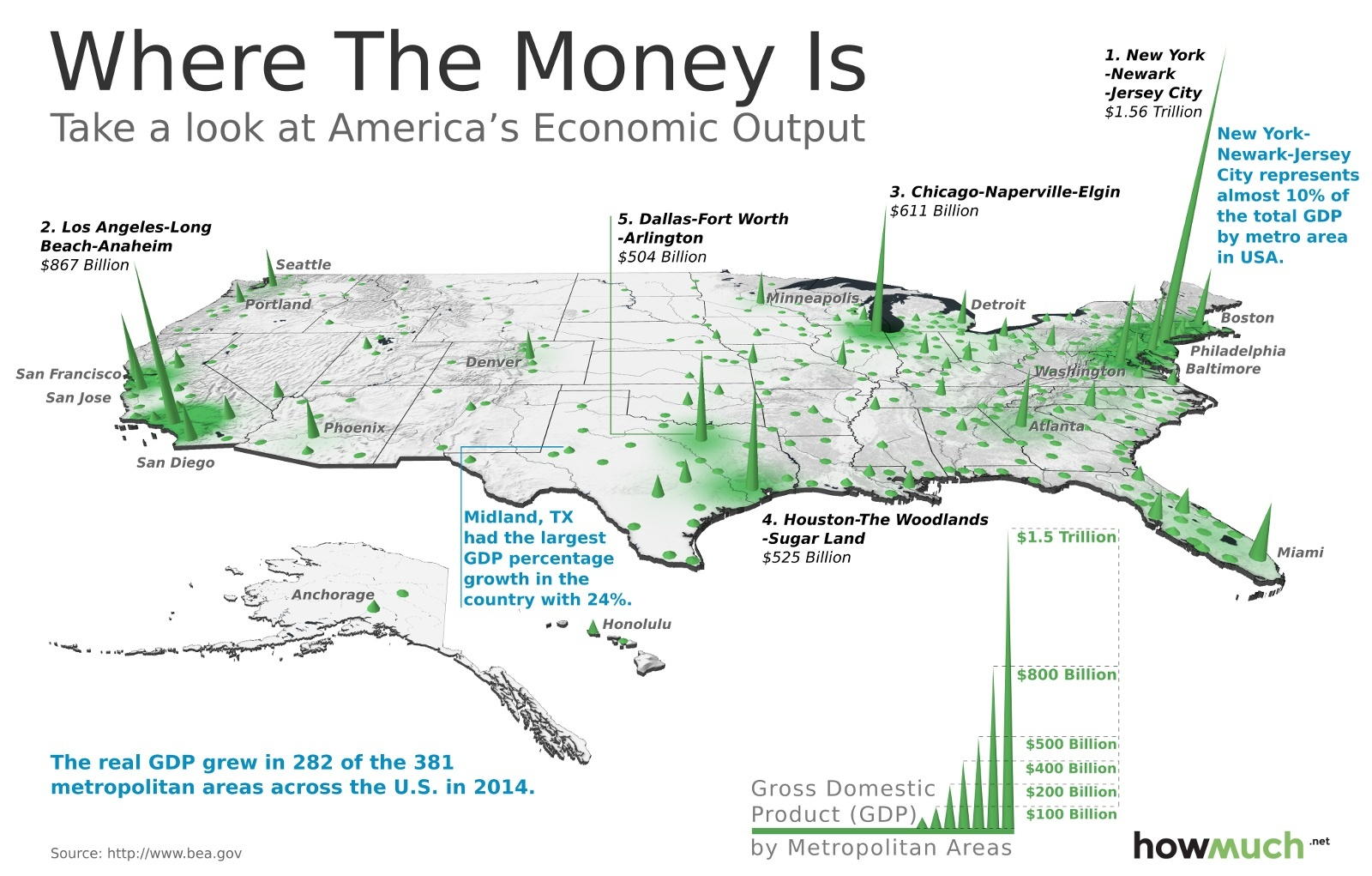
The Big Picture: “Where The Money Is – Take a look at America’s Economic Output” – howmuch.net 11/6
WP: Baby boomers are what’s wrong with America’s economy 11/5

WSJ: Apollo’s Deal for Control of Schorsch Real-Estate Empire Falls Apart 11/8

WSJ: What $1.5 Trillion in Stock Buybacks Doesn’t Buy 11/8

WSJ: Takeover Loans Have Few Takers on Wall Street 11/8

WSJ: London Office Development Hits Highest Level in Seven Years 11/10

WSJ: Rental Portion of One57 Is For Sale 11/10

WSJ: China Learns What Pushing on a String Feels Like 11/12

October 23 – October 29, 2015

China’s Economic Transition. Sovereign Wealth Funds – How can we reduce costs and increase returns? Corporate Profits Peaked?

This week three key themes that stood out were 1) how China’s economic transition from an investment-led economy to a consumption-led economy is by no means going smoothly as highlighted by The Wall Street Journal’s China’s Central Bank Moves to Spur Economic Growth and The Economist’s Debt in China – Deleveraging delayed 2) continuing on the reduction of petro-dollars in the investment markets how sovereign wealth funds are restructuring themselves to reduce costs while seeking out higher return investments (see The Financial Times’ Asset managers suffer as oil funds withdraw cash and Qatar fund backs Brookfield’s $8bn Manhattan West project), and 3) was a well written article (Peak Profits – The age of the torporation) in The Economist illustrating that corporations (or at least those that currently make up the major indices like the S&P 500) may have passed their profit peaks.

*Note: bold emphasis is mine.

China’s Central Bank Moves to Spur Economic Growth. Lingling Wei. Wall Street Journal.

First, before China entered into its Fifth Plenum this week and removed it’s one-child policy (changed to a two-child policy), the People’s Bank of China (PBOC) cut its benchmark one-year lending and deposit rates by 0.25% points (to 4.35% and 1.5% respectively), reduced banks’ reserve requirement ratios by 0.5% points and is removing caps on deposit rates that commercial banks can offer.

With the intention of lowering corporate financing costs and pumping liquidity into the economy, this

…was the sixth time since November that the Chinese Central bank has cut interest rates and the fourth across-the-board reduction of the amount of deposits banks are required to hold in reserve.

Zhu Chaoping, China economist at UOB Kay Hian Holdings Ltd., estimates the reduction in banks’ reserve requirements will pump about 680bn yuan ($108bn) worth of funds into China’s banking system.

“Taking such a rare action again means the real economy is performing poorly,” said a senior official at the PBOC. “A lot of companies have seen their profitability falling sharply and that’s a key reason why we took the action again today.”

Profits at Chinese industrial companies are down 8.8% in August year-over-year (the biggest monthly fall since 2011).

By loosening controls on deposit rates now, the government is attempting to inject market competition into a politically powerful state-run banking sector that has favored big state companies over a more dynamic private sector.

However, removing the deposit-rate ceiling also

“Removes one of the last remaining hurdles to satisfying the technical criteria set by the IMF” for designation of the yuan as a reserve currency. – Eswar Prasad, a Cornell University professor and former IMF China head.

The barrage of easing measures since late last year has had some success in getting more credit flowing in the economy. Chinese banks issued 1.05tn yuan of new loans last month, the highest on record. However, as credit continues to expand while growth slows, China risks a further buildup in debt. An analysis by consultancy McKinsey & Co. shows that China’s debt load increased by 282% of GDP last year from 158% in 2007.

Nice transition into:

Debt in China – Deleveraging delayed. The Economist.

It’s pretty simple, credit continues to grow faster than the economy so debt load to GDP will continue to increase.

China’s economy grew by 6.9% in the 3rd quarter, yet bank loans increased by 15.4% compared with the same period in 2014.

China’s overall debt-to-GDP ratio is continuing its steady upward climb (at 160% in 2007, now more than 240% – 161tn yuan ($25tn)). It has risen nearly 50% points over the past four years alone.

The question remains, what debt-to-GDP ratio becomes too high, and specifically for China (they have a much longer leash than a sovereign that doesn’t control its monetary policy, i.e. Greece, and then there is the whole +/- $3.5tn in reserves)? As Jim Chanos, famed short seller of Enron and founder/president of hedge fund Kynikos Assoc., pointed out in ValueWalk’s Jim Chanos: China Debt Surge Echoes 1990s Japan “we have an economy addicted to credit.”  While the country doesn’t appear to be facing an “imminent collapse,” it is on a trajectory similar to the one Japan was on before its asset-price collapse in 1991 “but on steroids.”

However, surprisingly the weighted interest rate on existing Chinese liabilities has fallen from roughly 6% to 4.5% this year.

Investors are lending to companies as if they were becoming safer borrowers, even as their liabilities increase.

Yang Chen of Bank of America Merrill Lynch notes that some investors are buying bonds with borrowed cash, believing that the government will wade in to spare them from any big defaults – as it has done in the past.

Wait… this seems vaguely familiar.  What’s that term…moral hazard.

Second,

Asset managers suffer as oil funds withdraw cash. Madison Marriage and Chris Newlands. The Financial Times.

Global asset managers are facing a double hit to their fees, as sovereign wealth funds withdraw billions to support their oil-dependent economies – and switch to a cheaper in-house investment approach.

Of the world’s 50 sovereign wealth funds, which collectively oversee about $6.5tn, one-third have reported a reduction in their invested assets. Of those affected, half derive their capital from oil, according to data provider Prequin.

The Saudi Arabian Monetary Agency, the world’s third-largest sovereign fund with $661bn invested – has withdrawn about $70bn from external asset managers.

Azerbaijan’s oil fund, which oversees $37bn of assets, has said in its annual report that it intends to bring the management of all of its assets in-house. It currently has $662m managed by State Street, the US financial service group, and $664m with Swiss bank UBS.

The Abu Dhabi Investment Authority – the second-largest sovereign fund globally with $773bn of assets – has also grown its in-house teams. It reduced its allocations to investment managers from 75% to 65% last year – in effect, a $77bn outflow from external fund houses.

State Street had outflows of $65bn in the second quarter of 2015, which it blamed partly on clients’ need for cash “due to lower commodity prices.”

Now consider this in conjunction with the efforts for transparency and to reduce fees at the likes of giant pension funds ala The California Public Employee’s Retirement System (Calpers) and the “Canadian model” of brining management in-house (the $125.2bn Ontario Teacher’s Pension Plan and the $54.7bn Ontario Municipal Employee’s Retirement System internally manage about 80% and 88% of their assets respectively) and you can see that the investment management field is under assault.  However, don’t misunderstand. Investors (individuals, pension funds, sovereign wealth funds, etc.) will continue to invest with hedge funds.  Ben Carlson of the blog A Wealth of Common Sense covered this extremely well in his October 11, 2015 post “Why People Invest in Hedge Funds,” so I won’t cover it here, basically investors invest in hedge funds because it’s too hard not to.

Hence,

Qatar fund backs Brookfield’s $8bn Manhattan West project. Henry Sender. The Financial Times.

Qatar Investment Authority is taking down a 44% stake in Brookfield’s $8bn Manhattan West real estate project – a 7m sq ft mixed-use development in NYC, west of Pennsylvania Station (part of the Hudson Yards area).

QIA’s investment comes as many sovereign wealth funds have been putting money into real estate at an earlier stage in than in the past – taking on development risk in pursuit of better returns.

Lastly,

Peak Profits The age of the torporation. The Economist.

For the second quarter in a row the sales and profits of members of the S&P 500 are expected to fall; for the three months to September they are forecast to be 3-5% lower than in the same period last year. Half of big listed American firms now have shrinking profits.

Worldwide earnings per share have stopped growing, measured in dollars. In local-currency terms sales growth has stalled in Asia, slowed in Europe and is expected to collapse in Brazil.

Earnings are high relative to two yardsticks: the S&P 500 earnings per share are 28% above their ten-year average and in America profits are stretched relative to GDP.  Further, the three general methods that have worked in the past to generate growing profits are no longer as easily available.  Specifically, 1) globalization – emerging markets are sputtering, the U.S. dollar is strengthening, and years of joint ventures in China have built competitors that better understand Chinese consumers and are better able at serving them, 2) finance – no longer the driver of profits it was up until 2007-2008, think of the finance arms of GE and GM, and 3) since 2007-2008 wages have been suppressed – there is definitely political pressure to change this.

If the share of domestic gross earnings paid in wages were to rise back to the average level of the 1990s, the profits of American firms would drop by a fifth.

So the quick fix has been share buy-backs (running at $600bn a year in America).

IBM spent $121bn on buy-backs over the past decade, twice what if forked out on research and development. Walmart spent $60bn on buy-backs.

Or cutting costs.

Even for Brazilian firm 3G which specializes in buying mature firms and cutting the “fat,” sales at its most recent target, Kraft are falling at a rate of 5% a year.

For all their obsession with growth, big listed firms appear paralyzed. They long to expand, yet also want to protect peak profits, restrain wages and investment, buy back shares and hold armfuls of excess cash on their balance-sheets.

Other Interesting Articles

Bloomberg Businessweek

The Economist

CNBC: America’s best malls have this tenant in common 10/23

FT: Investing in oil is a slippery slope 10/23

FT: China funding UK to build white elephants 10/23

FT: ‘Deflationary boom’ in prospect as China slows 10/26

NYT: A Global Chill in Commodity Demand Hits America’s Heartland 10/23

NYT: Greenland Is Melting Away 10/27

ValueWalk: Venezuela Selling Its Gold As It Runs Out of Cash 10/29

WSJ: How Global Easing Makes the Fed’s Job Harder 10/25

WSJ: Why It’s Not So Easy for China to Ease 10/26

WSJ: Sam Zell Edges Out of Apartments 10/26

WSJ: Morgan Stanley Makes a Comeback in Real Estate 10/27

WSJ: In China’s Alleyways, Underground Banks Move Money 10/27

WSJ: London and Hong Kong at ‘Risk of House Price Bubble’ 10/29

Special Reports

Bank of America Merrill Lynch: Transforming World Atlas – Investment themes illustrated by maps

Howard Marks – “Inspiration from the World of Sports” Memo – made available on www.marketfolly.com