Tag: Pensions

April 23, 2017

Worthy Insights / Opinion Pieces / Advice

A Wealth of Common Sense: Urgent vs. Important & the Power of Small Wins – Ben Carlson 4/20

Real Estate

LAT – When car ownership fades, this parking garage will be ready for its next life – Roger Vincent 4/16

Finance

WSJ – Grab Your Pitchforks, America, Your 401(k) May Need Defending from Congress – Jason Zweig 4/21

FT – US banks gain from rate rises as savers suffer – Alistair Gray 4/20

  • “Figures released by the biggest US banks in recent days show the industry is finally starting to profit from higher rates. Lending margins, which last year reached their lowest level in six decades, rose in the first quarter by the most in seven years.”
  • “If the eight basis point margin increase were to hold up across the sector, Autonomous analyst Brian Foran estimates the US banking industry would net an additional $11bn of interest income per year.”

Environment / Science

WP – Thousands of tiny satellites are about to go into space and possibly ruin it forever – Avi Selk 4/21

  • “Hundreds of thousands of bits of space junk are orbiting Earth, according to NASA. These include tiny paint flecks that can take out a space shuttle window, and some 2,000 satellite shards left by a collision of Russian and American satellites several years ago.”
  • Further, “as satellites get smaller and cheaper, more and more of them are going into orbit to potentially smash into each other.”
  • “In February, the New York Times reported, India launched 104 tiny satellites into space from a single rocket.”
  • “In all of human history… about 7,000 spacecraft have left the Earth…[and] 12,000 new satellites are set to go up soon…”
  • What’s new is that “many of these – like the batch India sent into space – are nano-satellites: tiny, motorless machines that promise to revolutionize communications.”
  • Great, except that they are not maneuverable and dramatically increase the odds of collision…

China

FT – China bond party attracts few takers – Gabriel Wildau 4/20

April 18, 2017

Markets / Economy

Economist – Cash-strapped pensioners: America has a retirement problem, not a saving problem 4/18

Finance

WSJ – The Risk of Rising Consumer Borrowing – Aaron Back 4/17

China

Value Walk – If The China Property Bubble Bursts, Banks And Individual Wealth Likely More Impacted – Mark Melin 4/12

  • “The risk of the China property bubble bursting and impacting the macroeconomic environment ‘has become more pronounced,’ Moody’s analysis observes. In fact, if a property bubble does burst, its impact would be more diffuse, impacting not only the supply chain as it has in the past, but more significantly the banking system and consumer wealth effect.”
  • “The impact of home ownership on household wealth has been on the rise. In 2013, it represented 62.3% of all Chinese personal wealth and has steadily risen since. In 2015 it was 65.3% and in 2016 it grew to 68.8% of all wealth in the Asian nation.”

WSJ – The Danger in China’s Dual Debt Cycle – Anjani Trivedi 4/18

March 3 – March 9, 2017

In the UK the economy has grown but wages have declined. Does your bond index have Chinese bonds – it will soon. The Puerto Rican teacher’s pension ponzi scheme (really several US states and cities aren’t far away from a similar situation).

Headlines

WSJ – Macau Casinos Face Impending Shuffling of Decks 3/2. Two of the six casino operators will see their gambling concessions expire in 2020 and the other four in 2022. At that time expect the cost-of-doing business to increase enormously, the public tender to go to mainland Chinese companies (as opposed to foreigners), or the number of concessions to increase – either way, competition will be fierce.

NYT – Sweden Reinstates Conscription, With an Eye on Russia 3/2. Abolished in 2010, Sweden is reinstating the draft starting next year.

FT – Wealth of China’s richest 200 lawmakers tops $500bn 3/2. “According to Hurun data, the 200 richest members of the National People’s Congress and Chinese People’s Political Consultative Congress, an advisory body, have combined fortunes worth nearly Rmb3.5tn ($507bn). The wealth of the 100 richest lawmakers soared over the past four years to Rmb3tn, up from Rmb1.64tn in 2013.”

FT – US and North Korea on collision course, says China 3/7. The U.S. has sent its THAAD missile defense system to South Korea in light of increasing aggression from North Korea – despite concern from China.

Bloomberg – L.A. Voters Reject Measure AIDS Group Backed, Developers Opposed 3/8. LA voters rejected ballot Measure S that sought to put a two-year moratorium on development in LA.

Economist – The Iraqi army is on the brink of defeating Islamic State 3/8. “But the government must move fast if it is not to squander its victory.”

Bloomberg – Manhattan Rents Fall for Every Apartment Size, Even Studios 3/9. “Apartments available for rent at the end of February totaled 6,872, a jump of almost 12% from a year earlier. The number of new leases fell 28% last month to 3,634, while the median monthly rent for units of all sizes slipped 0.9% to $3,350.”

Special Reports / Opinion Pieces

Briefs

  • Cat Rutter Pooley and Attracta Mooney of the Financial Times highlighted that US pension funds have halved their private equity allocations.
    • “Big US investors have halved their allocations to private equity this year. It is the first sign that pension funds are concerned investment returns will suffer as buyout houses struggle to deploy record levels of cash.”
    • “Pension funds and other institutional investors gave $3.2bn to private equity funds in January and February compared with $8.9bn announced during the same period last year, according to data from MandateWire, the FT news service that collected the figures.”
    • Why… “investors are now worried about lower returns and difficulties exiting their investment in the future, as the number of initial public offerings decreases.” Further, “there are also concerns that the private equity market has become overcrowded, with buyout companies struggling to find suitable businesses to back.”
    • “According to a report from Pitchbook, the data provider, the level of cash, so-called dry powder, that private equity companies have to invest hit a record high of $754bn in 2016.”
    • “More than 80% of the capital raised by private equity companies in 2015 has yet to be deployed, said Pitchbook.”
  • Gabriel Wildau of the Financial Times covered the milestone that China has overtaken the eurozone as the world’s biggest banking system.
    • “China’s banking system has surpassed that of the eurozone to become the world’s largest by assets, a sign both of the country’s increased influence in world finance and its reliance on debt to drive growth since the global financial crisis.”
    • “While China’s gross domestic product surpassed the EU’s economic bloc in 2011 at market exchange rates, its banking system did not take over the top spot until the end of 2016, Financial Times analysis shows.”
    • “Chinese bank assets hit $33bn at the end of 2016, versus $31tn for the eurozone, $16tn for the US and $7tn for Japan. The value of China’s banking system is more than 3.1 times the size of the country’s annual economic output, compared with 2.8 times for the eurozone and its banks.”
    • As Esward Prasad, former China head at the International Monetary Fund and an economist at Cornell University, “the massive size of China’s banking system is less a cause for celebration than a sign of an economy overly dependent on bank-financed investment, beset by inefficient resource allocation, and subject to enormous credit risks.”
  • Bloomberg News illustrated that capital controls have triggered a backlash amongst China’s corporate titans resulting from scrapped deals.
    • “Chinese corporate chiefs are turning vocal critics of the nation’s capital controls as the pile of scrapped deals grows.”
    • “The complaints reflect a tumble in foreign deals, with the $19 billion of acquisitions abroad announced by Chinese companies so far this year amounting to a 74% drop from a year ago, according to data compiled by Bloomberg.”
    • “China’s leadership faces a balancing act in trying to stoke domestic companies’ influence on the international stage while avoiding the kind of bad investments that Japanese firms became famous for in the 1980s. The more immediate concern has been record outflows of capital that have only diminished in recent months after a steady tightening in oversight of and limits on cross-border transactions.”
  • Justin Lahart of The Wall Street Journal discussed a taxing problem for investors
    • “A corporate tax cut could provide a big boost to companies’ profits. The boost might not be quite as big, or come as soon, as investors think, though.”
    • “Yes, the U.S. corporate tax rate, at 35%, is among the world’s highest. President Donald Trump and the Republican-led Congress aim to change that. Mr. Trump has proposed dropping it to 15%, while the plan that House Republicans drew up last June would lower it to 20%.”
    • “So by how much would a tax cut juice corporate profits? The first thing to recognize is that few large public companies pay the statutory rate. By Goldman Sach’s reckoning, the effective tax rate for companies in the S&P 500 – which includes not just federal, but also state and local taxes – is 28%. Under the House plan, Goldman figures it would drop to 24%, boosting after-tax earnings by about 10%.”
    • “That could make the stock market look significantly less rich. The S&P 500 now trades at about 18 times analysts’ expected earnings for 2016, according to FactSet. Raise earnings by 10% and that price / earnings ratio slips to a more reasonable but still expensive 16.4.”
    • However, “a lower corporate tax rate also might convince some companies to reassess their use of tax havens, notes Tax Policy Center co-director Eric Toder. Any profits they direct toward the U.S. would then be subjected to a higher tax rate (20% is low, but Bermuda’s 0% is lower), raising their tax rate. Thus, the effective rate might not fall as much as advertised.”
    • Bottom line, “stock prices are supposed to be a reflection of expected future earnings. If investors are expecting too much from a corporate tax cut, and expect it to come too early, then prices will have to come down.”
  • Ben McLannahan and Barney Jopson of the Financial Times highlighted that over the past election cycle Wall Street spent a record $2bn on US election influence.
    • “Wall Street spent a record $2bn on lobbying and campaign contributions during the last US election cycle, according to a new survey, as big banks, hedge funds and other financial institutions stepped up efforts to reshape rules to their advantage.”
    • “Contributions of $1.1bn in the two years ended December 2016, combined with payments to lobbyists of $898m, meant that spending by Wall Street topped $2bn, about 25% higher than the previous high in 2007-2008.”
    • “The election contributions went to both presidential campaigns and congressional races, with donors sticking to the common practice of spreading their largesse across both parties.”
    • “The sums do not include so-called ‘dark money,’ or support to non-profits which do not have to disclose their donors. Nor do they include spending on research or policy staff who are not registered as lobbyists.”
    • “The financial sector is by far the largest source of campaign contributions to federal candidates and parties and ranks as the third-largest spender on lobbying, according to the survey [done by Americans for Financial Reform, a left-leaning coalition of consumer, labor and community groups], which was based on data collected by the Center for Responsive Politics. Insurers (excluding health insurers) were the biggest spenders during the last cycle, with $224m, followed by securities and investment ($192m) and real estate ($183m).”
    • Lisa Donner, executive director of Americans for Financial Reform, “noted that there were few outright victories for Wall Street in recent years, as lobbyists sought to roll back Dodd-Frank reforms. One example was a battle in December 2014 which allowed the big banks to continue to fund derivatives trades using federally-insured deposits.”
    • “But she said that much of the lobbying had succeeded in ‘slowing or weakening’ proposed reforms. Rules on curbing incentive pay, for example, have yet to see the light of day, even though such measures appear to have broad support among voters.”
    • “‘That is really what the money story is about; we end up with outcomes that are not what people voted for,’ said Ms. Donner.”

Graphics

WSJ – Daily Shot: Statista – Tech IPO performance 3/2

WSJ – Daily Shot: Reliance on Undocumented Labor 3/2

WSJ – Daily Shot: Migrant Hosting and Sending Countries 3/2

WSJ – China Shifts Stance, Letting Dying Firms Go Bankrupt – Chuin-Wei Yap 3/3

WSJ – Daily Shot: Goldman Sachs – US Auto Inventory 3/5

Bloomberg – Saudi Arabia Still Bears Brunt of Oil Cuts as OPEC Output Drops – Angelina Rascouet and Julian Lee 3/2

NYT – ‘Superstar Firms’ May Have Shrunk Workers’ Share of Income – Patricia Cohen 3/8

WSJ – Americans Are Richer Than Ever, But They Don’t Feel That Way – Steven Russolillo 3/8

Featured

*Note: bold emphasis is mine, italic sections are from the articles.

How wages fell in the UK while the economy grew. Valentina Romei. Financial Times. 2 Mar. 2017.

“Between 2007 and 2015, the UK was the only big advanced economy in which wages contracted while the economy expanded. In most other countries, including France and Germany, both the economy and wages have grown.”

“Britain’s GDP went back to pre-crisis levels in the third quarter of 2013 and it is now nearly 10% larger than in the second quarter of 2008. Yet in 2014 wages were almost 10% lower than seven years before. During the same period, salaries in France and Germany grew 7%.”

“Only the US and Canada have greater flexibility in labor market regulation than the UK, according to the OECD. Thanks to a more flexible job market, people were able to find jobs quicker than in other countries. Employment expanded by 2.4% in the six years to 2013, while in France there was no job expansion and the EU as a whole experienced job losses.”

What gives…

“After the crisis, labor supply increased, but these ‘unusual increases in labor supply’ were absorbed by the market, writes the OECD in its latest country survey. Pension reform and other policies contributed to the increase in supply with a rising number of older workers and incentives to work rather than live off benefits. Meanwhile ‘sustained inflows of well-educated immigrants have boosted the working-age population,’ says the OECD.”

“Such employment expansion coincided with the loss of labor bargaining power due to the risk of unemployment and ‘slack’ remaining higher than pre-crisis levels. Unemployment, underemployment and involuntary part-time working, for example, were far above their levels in 2008. Coupled with low and falling levels of unionization, employment growth came at the expense of a fall in real wages.”

While the economy is close to full employment, instead of tight labor conditions pushing up wages, there is enough slack and labor demand that wages are soft.

Unfortunately, “inflation is likely to squeeze real wages in the next couple of years just as it did after the crisis.” Rather than higher prices for goods and services feeding into higher profits and higher wages, productivity growth has languished, so people are dealing with lower living standards.

“Between 2007 and 2015 the UK had one of the highest inflation rates among big advanced economies, largely because of high energy prices and the depreciation of the pound. Consumer prices expanded at an annual rate of over 5% at their peak in September 2011, well above the rate of expansion of nominal earnings.”

Further “employment growth was driven largely by self-employment and part-timers, while the number of full-time jobs shrank. ‘The rapid rises in employment over the past few years have been made up by a larger than usual share of low-skilled jobs which tend to be lower paid,’ say Capital Economics.”

China’s Massive Bond Market Coming to Index Near You. Anjani Trivedi. The Wall Street Journal. 7 Mar. 2017.

“China’s bond-market dreams could finally be coming true. But global investors should tread with care.”

“Citigroup announced Tuesday that mainland Chinese bonds were eligible for inclusion in its widely followed indexes of investment-grade bonds. Once included, most passive investors could end up holding Chinese bonds in some way in their portfolios. Citi says the entry will be staggered over three months given the overall Chinese market’s $9 trillion size.”

“Index inclusion is big business – and isn’t a sleep subject. Opening the world up to China, also opens the world up to a host of risks that investors haven’t quite figured out how to price.”

“Even though Beijing is seemingly freeing up its bond markets, repatriating funds remains an issue. A recently introduced currency-hedging tool helps, but details are still fuzzy. And the risk of sudden capital controls perpetually looms.”

“For China, this could mean much needed inflows into its financial markets to counter the billions of monthly outflows. Around $2 trillion of assets under management track Citi’s World Government Bond Index. That could mean inflows of up to $120 billion if China has a 5% to 6% weight, according to Goldman Sachs. ETF’s like Tokyo-listed Listed Index Fund also track the Citi World Government Gond Index as do some BlackRock government bond funds.”

To be fair, it’s hard not to include bonds from the world’s second largest economy.

“There are fundamental issues to contend with especially the market’s lack of discernment between safe and risky bonds as reflected in narrow credit spreads. Foreign presence is unlikely to instill such discipline anytime soon.”

“Concerns around a host of trading technicalities abound…. Along with adding China to its main indexes, Citi has created two new ones that cap exposure, perhaps a hint that for many, China’s inclusion is too soon.”

“Ready or not, China’s bond market is joining an important club.”

The Chinese government, but more importantly, Chinese corporates will be able to pass on their debt risks to foreign investors and the sheer mechanics of indexes create a relatively indiscriminate buyer… the proverbial can continues to be kicked down the road.

In Puerto Rico, Teachers’ Pension Fund Works Like a Ponzi Scheme. Mary Williams Walsh. The New York Times. 8 Mar. 2017.

“Puerto Rico, where the money to pay teachers’ pensions is expected to run out next year, has become a particularly extreme example of a problem facing states including Illinois, New Jersey and Pennsylvania: As teachers’ pension costs keep rising, young teachers are being squeezed – sometimes hard. One study found that more than three-fourths of all American teachers hired at age 25 will end up paying more into pension plans than they ever get back.”

“‘I think they’re really being taken advantage of,’ said Richard W. Johnson of the Urban Institute, a co-author of the research. ‘What’s so tragic about this is, often the new hires aren’t aware that they’re getting such a bad deal.'”

“The problem is magnified by the fact that the Puerto Rico teachers union – like many teachers and police unions around the country – opted out of Social Security long ago, hoping it could save both workers and the government money by not paying Social Security taxes.”

Conceptually, “pension funds are supposed to be giant, largely self-sustaining pools of money, contributed by taxpayers and often workers, that earn investment income. Over time, the money is supposed to grow enough to pay retirees. Knowing this, teachers might reasonably expect to get a pension worth more than what they invested.”

However, in Puerto Rico “the pension funds are so short of cash that money contributed by working teachers basically flows straight out to retirees. None of Puerto Rico’s current teachers can expect to get their money back, because the fund is due to run out of money in 2018, long before they retire.”

“That is, essentially, a Ponzi scheme. But this structure is legal in Puerto Rico because of a complicated series of changes in the law brought about in recent years by the island’s financial crisis.”

Back to pension programs in general, “benefits are typically backloaded. This means that teachers build up their benefits very slowly in their early years – even as they make big contributions – then speed up in middle age and earn the biggest part just before they retire.”

“But because of high turnover and other factors, relatively few teachers reach the sweet spot where they earn a pension larger than their contributions. Most change jobs or move away first, leaving behind money that subsidizes the pensions of the relative few who teach for decades.”

Regardless, pension stress resulting from largess promised in good times and a lower investment return world have led to major cuts to younger teachers in the system. “In Illinois, for example, Mr. Johnson of the Urban Institute found that a teacher hired at age 25 who worked for 35 years could earn a pension worth $1.3 million – as long as that teacher had been hired before 2011. If hired after 2011, the same teacher would earn a pension worth only $609,000, even though both groups contribute 8.4% of every paycheck.”

“‘Overall, 84% of all newly hired teachers lose money’ in Illinois, Mr. Johnson said.”

Further, eight states (Delaware, Hawaii, Illinois, Maryland, New York, North Carolina, Pennsylvania, and West Virginia) recently doubled their vesting periods (“the time a teacher must work before vesting, or earning a nonforfeitable right to a pension”) to 10 years. “That is more than three times the maximum allowed for companies.” On top of that, “three of every 10 new teachers will quit in five years or less.” Basically free money for these pension programs.

“Martin F. Lueken of EdChoice, formerly the Friedman Foundation for Educational Choice, looked at the largest school districts in each state and found three where, because of cost-cutting, newer teachers might work their whole careers without ever earning a pension worth the value of their contributions: Boston, Chicago and the northern suburbs of Minneapolis.”

For more see: NYT – The State of State Teachers’ Pension Plans – Karl Russell and Mary Williams Walsh 3/6

Other Interesting Articles

Bloomberg Businessweek

The Economist


Bloomberg – These Economies Are Getting More Miserable This Year 3/2

Bloomberg – Shale Billionaire Hamm Says Industry Binge Can ‘Kill’ Oil Market 3/8

FT – India optimistic of being coal-free by 2050 2/12

FT – Investors place derivate bet against US shopping centers 3/2

FT – Japan returns to inflation for first time since 2015 3/3

FT – Jack Bogle: ETFs have beaten hedge funds 3/4

FT – China warns on hidden local government debt risks 3/5

FT – China defense budget tops Rmb1tn for first time 3/5

FT – Macau’s regional challengers up their casino game 3/5

FT – European businesses attack China high-tech push 3/6

FT – Germany’s trade surplus sparks concern at home and abroad 3/6

FT – Norway’s $905bn oil fund flexes its shareholder muscles 3/7

FT – Global investors return to China’s bad debt market 3/7

GlobeSt – Wave of Apt. Deliveries Will Crest In 2017 3/2

NYT – Here’s the Reality About Illegal Immigrants in the United States 3/6

WSJ – Disturbing New Facts About American Capitalism – Jason Zweig 3/3

WSJ – What GM Is Paying for European Exit 3/6

WSJ – Charity Officials Are Increasingly Receiving Million-Dollar Paydays 3/6

WSJ – Short Sellers Target Mall REITs 3/7

WSJ – Miami Condo Market Cools, but a Big Project Gets Financings 3/7

WSJ – Renovate America, One of America’s Fastest-Growing Lenders, Didn’t Disclose It Made Payments to Some Borrowers 3/8

WSJ – New Force on Wall Street: The ‘Family Office’ 3/8


February 17 – February 23, 2017

US Baby Boomer generation making peace with less. Lots of US consumers are behind on their car payments. Banks are taking a step back from lending to the apartment market.

Headlines

FT – Norway plans shake-up of $900bn oil fund 2/16. The sovereign wealth fund of Norway – the largest in the world, “which already owns 1.3% of every listed company” –  is planning on upping its allocation to equities to 70% from 60%.

FT – China bans coal imports from North Korea 2/18. Apparently North Korea finally crossed a line when it recently assassinated Kim Jong Nam (older brother of North Korean ruler Kim Jong Un) in Malaysia – who by the way was under Chinese protection.

WSJ – Chinese Bank Cleanup Plan Could Leave a Mess 2/20. The growth in the use of wealth-management products by Chinese banks continues to surge so the People’s Bank of China is seeking ways to bring the products on to bank balance sheets to get a better handle of the risk in the system.

Special Reports / Opinion Pieces

Briefs

  • Clifford Krauss of The New York Times highlighted that while Texas oil fields are rebounding from the price lull, jobs are being left behind.
    • “Roughly 163,000 oil jobs were lost nationally from the 2014 peak, or about 30% of the total, while oil prices plummeted, at one point by as much as 70%. The job losses just in Texas, the most productive oil-producing state, totaled 98,000.”
    • “Several thousand workers have come back to work in recent months as the price of oil has begun to rise again, but energy experts say that between a third and a half of the workers who lost their jobs are not returning.”
    • “And despite all the lost workers, United States oil production is galloping upward, to nine million barrels a day from 8.6 million in September. Nationwide, with a bit more than one-third as many rigs operating as in 2014, production is not even down 10% from record levels.
    • “Some of the best wells here in the Permian Basin that three years ago required an oil price of over $60 a barrel for an operator to break even now need about $35, well below the current price of about $53.”
    • “Pioneer Natural Resources, one of the most productive West Texas producers, has slashed the number of days to drill and complete wells so drastically that it has been able to cut costs by 25% in wells completed since early 2015. The typical rig that drilled eight to 12 wells a year just a few years ago now drills up to 16. Last year, the company added nearly 240 wells to its Permian Basin inventory without adding new employees.”
  • Gabriel Wildau of the Financial Times covered how the People’s Bank of China has launched a fresh new attack on shadow banking risk in the system.
    • “China’s central bank has drafted new rules to tackle risks from shadow banking, in a tacit acknowledgment that a host of measures in recent years to control off balance sheet credit have failed to control its risks.”
    • “New credit hit a record high in January, mostly due to lending by non-bank institutions. UBS estimates that China’s ratio of debt to gross domestic product hit 277% at the end of 2016, up 133 percentage points since the global financial crisis. Non-bank lending has grown the fastest.”
    • “Chinese banks’ off balance sheet wealth management products (WMPs) exceeded Rmb26tn ($3.8tn) by the end of 2016, up 30% from a year earlier, compared with 10% growth for bank loans, the PBoC said. Non-bank financial institutions like trusts, securities brokerages and insurers package loans into investment products, which banks sell to clients as a high yield alternative to traditional savings deposits.”
    • “The PBoC has circulated a draft policy framework in recent days that forbids off balance sheet WMPs from investing in illiquid loans known as ‘non-standard’ credit assets, Caixin, a respected financial news website, reported on Wednesday. ‘Standard’ assets refers to stocks, bonds and money market assets.”
    • “The guidelines also seek to end the implicit guarantees associated with many WMPs… [and] also set uniform leverage ratios for structured WMPs…”
    • “The rules also forbid WMPs from taking other WMPs as their underlying assets, a practice reminiscent of ‘synthetic’ collateralized debt obligations popular in the US before the 2008 financial crisis.”

Graphics

FT – It’s an issuer’s market in US corporate bonds – Stephen Foley 2/16

ft_us-corporate-bond-spreads_2-16-17

WSJ – Nascar, Once a Cultural Icon, Hits the Skids – Tripp Mickle and Valerie Bauerlein 2/21

wsj_nascar-viewership_2-21-17

WSJ – Daily Shot: Classic Rock Preferences Across America 2/20

wsj_daily-shot_classic-rock-preferences-america_2-20-17

WSJ – Daily Shot: US – Mortgage Origination By Credit Score 2/21

  • “Mortgage credit remains tight, with the borrowers’ median credit score still above 760.”

wsj_daily-shot_us-mortgage-origination-by-credit-score_2-21-17

Economist – A new paper finds China more unequal than France but less so than America 2/16

economist_income-inequality_china-us-france_2-16-17

WSJ – Daily Shot: U.S. Public Perception of crime rate 2/22

wsj_daily-shot_us-public-perception-of-crime-rate_2-22-17
FT – Chinese province’s GDP fall hints at extent of past exaggeration – Yuan Yang 2/22

ft_liaoning-province-nominal-gdp-growth_2-22-17

Featured

*Note: bold emphasis is mine, italic sections are from the articles.

With $15 Left in the Bank, a Baby Boomer Makes Peace With Less. Timothy Martin. The Wall Street Journal. 16 Feb. 2017.

“People in the U.S. ages 65 to 74 hold more than five times the borrowing obligations Americans their age held two decades ago, according to an analysis of federal data by the Employee Benefit Research Institute, a nonpartisan, nonprofit policy researcher.”

“Paying it off won’t be easy. Median savings for U.S. households nearest retirement age has dropped 32% in the past decade to $14,500, according to an analysis of federal data by the Economic Policy Institute, a left-leaning think tank.”

“‘This is the first time where we have seen such a high degree of debt held by people at such a late stage of life,’ said Torsten Slok, chief international economist at Deutsche Bank AG.”

“As a result, many senior citizens will either have to work longer, move to less expensive places or pare back their spending – choices that economists say are likely to put a drag on the U.S. economy.”

wsj_american-net-worth-ages-55-64_2-16-17

“By the end of 2015, residents ages 66 to 70 had accumulated $99,700 in debt compared with $90,600 a decade before; 71- to 75-year-old residents had $73,400 versus $58,800 over the same period; and those ages 76 and older had $52,100 compared with $28,200, according to Equifax data.”

wsj_maturing-americans-aged-65-debt-burdens_2-16-17

One million US consumers behind on car loan payments. Alistair Gray. Financial Times. 16 Feb. 2017.

“More than a million US consumers have fallen at least two months behind on car loan repayments as the delinquency rate reaches its highest level since 2009, in the latest sign of stress in the $1.1tn market.”

“The proportion of soured car loans showed a 13% increase to 1.44% in 2016, according to data published on Thursday by TransUnion, the US credit bureau with an anonymized database of 220m consumers.”

ft_us-car-loans_2-16-17

“Delinquencies on credit cards also rose by about the same amount over the period to 1.79% – the highest since 2011.”

“The rise in bad loans comes despite persistently low borrowing costs and unemployment levels – suggesting lenders may be letting consumers take on bigger debt burdens than they can handle. Lending to consumers with weak credit scores has been one of the fastest growing parts of the industry.”

“Separate figures published on Thursday by the New York Federal Reserve showed the total amount of debt held by American households rose last year at the fastest clip since 2007. Increases in all the main categories, from mortgages to student loans, pushed the total up $460bn over the year to $12.58tn – only 0.8% shy of the peak reached in the third quarter of 2008, the height of the financial crisis.”

Banks Retreat From Apartment Market. Laura Kusisto. The Wall Street Journal. 21 Feb. 2017.

“Swelling supplies of apartment units are prompting big banks to pull back from new projects, forcing developers to scramble for capital, in a sign that the U.S. apartment industry is headed for a downturn.”

“The apartment sector, which contributes some $284 billion to the economy annually, has been a winning bet for investors since the housing crash, as the economy recovered and more renters sought out units. Since 2010, average U.S. apartment rents have increased by 26%, according to data tracker MPF Research, a division of RealPage.”

“But fresh supply is beginning to overwhelm demand. More than 378,000 new apartments are expected to be completed in 2017, a 30-year high, according to real estate researcher Axiometrics Inc. In the fourth quarter of last year, 88,000 units were completed but only 50,000 of those were rented by tenants, according to MPF.”

“Now banks are in retreat, forcing developers to look to nontraditional lenders and seek more expensive types of financing to complete projects, said apartment executives, industry analysts, mortgage brokers and bankers.”

“In congressional testimony last week, Federal Reserve Chairwoman Janet Yellen noted that banks have started pulling back from making commercial real-estate loans, which could be a sign of ‘some reduction in appetite.'”

“While a couple of years ago most could get loans for about 65% of the cost to build a project, today they are getting closer to 55%” according to Peter Donovan, executive managing director of multifamily capital markets at real-estate brokerage CBRE.

As Donovan put it, “we’re certainly seeing the pullback. It was almost as if all the banks got the same memo.”

“Adding to the risk for developers: Even as loans get more expensive, rent growth is slowing. Last year, average U.S. apartment rents rose 3.8%, a significant drop from the recent high of 5.6% year-over-year growth posted in the third quarter of 2015, according to MPF.”

“Rents in major cities, such as San Francisco, New York, Houston and San Jose, Calif., all declined about 1% in 2016 from 2015 levels.”

Other Interesting Articles

Bloomberg Businessweek

The Economist

Bloomberg – A Billion Barrels of Bets Backing Stagnant Oil Price: Chart 2/20

Bloomberg – Why Trump’s Immigration Crackdown Could Sink U.S. Home Prices 2/22

Bloomberg – Saudi Arabia’s Oil Wealth Is About to Get a Reality Check 2/23

CNBC – Manhattan condo market cracking, developers roll out big incentives 2/17

FT – Hedgies hope insurers will rush in where others fear to tread 2/17

FT – ‘Aggressive’ vulture funds swoop in on Irish property 2/18

FT – China to slash drug distribution groups in price drive 2/19

FT – Foreign buyers fire up South Korea commercial property market 2/19

FT – Investors snap up inflation-proof gilt at record negative yield 2/21

FT – Snap and the 21st century governance vacuum 2/22

FT – Private placements up next for China’s whack-a-mole regulators 2/22

NYT – A Push for Diesel Leaves London Gasping Amid Record Pollution 2/17

NYT – Where the Booze Can Kill, and Putin Is Deemed a ‘Good Czar’ 2/18

NYT – SolarCity’s Ties to Foreclosure Cases Raise Questions on Vetting Policies 2/22

ValueWalk – How The Slowing Shipping Industry Could Spark A Banking Crash in Germany 2/21

WSJ – How Saudis Cut Oil Output Without Really Cutting 2/16

WSJ – Mall Landlords’ Next Act: Apartments and Concerts 2/21

WSJ – The Inevitable Turn in World’s Most Important Property Market 2/22

WSJ – Office Landlords Struggle to Raise Rents 2/22

WSJ – Only a Market Crash Can Stop Warren Buffett From Winning This $1 Million Bet 2/23

WSJ – Luxury Home Sellers Slash Millions Off Asking Prices 2/23

December 9 – December 15, 2016

You can be certain that China is doing what it can to buy local. A US municipal pension crisis takes center stage in Dallas. Yeah, interest rates are going up – oh wait, what…

Headlines

Special Reports / Opinion Pieces

Briefs

  • Martin Sandbu of the Financial Times added some context to Opec’s recent production cut agreement with non-Opec member countries and likened it to a swan song.
    • Oil has rallied on recent production cuts agreed to by both OPEC and key non-OPEC countries (Russia).
    • “To top it off, Saudi Arabia’s oil minister signaled a willingness to cut, if necessary, even beyond the agreed limits to prop up prices – an announcement billed by some as a ‘whatever it takes’ moment to warn markets off testing the cartel’s resolve.”
    • However, the oil industry has changed and the US Shale producers are challenging Saudi Arabia for the key swing producer status. Two key facts to consider are 1) “…the break-even price for many shale producers is coming down  surprisingly fast. That means that the level at which shale can replace any OPEC cutback keeps going lower.” And 2) “…that, partly due to its manufacturing-style cost structure, shale is a dispersed private activity. Especially in market economies, it would be very difficult to decide production levels strategically even if one wanted to. So if US shale oil takes over Saudi Arabia as the global market’s swing producer, it will behave in a very different, and largely unstrategic, manner.”
    • “All this means is that OPEC – even with its new non-OPEC friends – has largely used up its ammunition by driving prices to where they are now.”
  • Tom Mitchell of the Financial Times illustrated how Trump’s policy shifts pose ‘unthinkable’ risks for China investors.
    • “We do not take an outbreak of a US-China trade war as our baseline case… But the … US election clearly show[s] how the conventional wisdom in economics may backfire these days. We need to think of previously unthinkable risk scenarios.” – Zhiwei Zhang, economist at Deutsche Bank
    • In regard to new capital controls, the “companies most at risk from the restrictions on dividend remittances include large automakers GM, Volkswagen and Toyota, for whom China is their largest and most profitable market.”
    • “Left to its own devices, the ruling Chinese Communist party would rather not restrict foreign investors’ dividends or punish American multinationals, even if Mr. Trump does indeed upend Sino-US relations…. Last week the party’s politburo identified ‘actively attracting foreign investment’ as one of its key ‘economic work tasks’ for 2017.”
    • “The risk for US multinationals lies in the fact that the Communist party is not entirely free to decide how it reacts to foreign ‘provocations.’ The party’s hand can be forced if an increasingly nationalist public feels the leadership is not being assertive enough in defense of territorial interests.”
    • It would seem the counter-argument would be that the Communist party should be able to pacify its citizens through its control of the media and propaganda apparatus, but as we’ve seen state-side, false news spreads far-and-wide and can affect people’s beliefs and behaviors.

 Graphics

FT – The ECB, bond buying and the capital key: a Q&A – Elaine Moore 9/7

ft_ecb-capital-key_9-7-16

FT – Casino stocks jolted by Macau ATM limit reports – Peter Wells 12/8

ft_macau-exposed-casino-stocks_12-8-16

FT – Amazon’s no-checkout store threatens death of the cashier – Mark Vandevelde and Lindsay Whipp 12/8

ft_us-jobs-outlook_12-8-16

ft_us-job-distribution_12-8-16

WSJ – Daily Shot: BAML EM High Yield Index (Spread) 12/9

  • “Despite higher bond yields, the global chase for yield continues.”

wsj_daily-shot-baml-em-hy-index-spread_12-9-16

Bloomberg – Good Luck Privatizing the American Dream – Mark Whitehouse 12/12

bloomberg_subsidizing-the-american-dream_12-12-16

WSJ – The Simple Truth About China’s Economy – Nathaniel Taplin 12/13

wsj_china-credit-re-inv-and-steel-changes_12-13-16

Bloomberg – Tokyo Regains Costliest City for Expats Title as London Drops – David Roman 12/14

bloomberg_worlds-20-most-expensive-cities-for-expats_12-14-16

Featured

*Note: bold emphasis is mine, italic sections are from the articles.

South Korea, Germany at risk from China tech rise. James Kynge. Financial Times. 13 Dec. 2016.

According to a recent report by The Mercator Institute for China Studies (Merics), a Berlin-based think-tank, the “Made in China 2025” plan is going to dramatically alter the market for a number of industrial countries that rely on China for a large portion of their sales.

“Industrial countries should have no illusions: Made in China 2025 will elevate a small but powerful group of Chinese manufacturers, dramatically increasing their competitiveness.”

“The Czech Republic, Germany, Italy, Hungary, Japan and South Korea are most at risk from the strategy because each of them derives more than 40% of the value of their industrial output from the high-tech and medium-tech industries that are targeted in China’s plan.”

ft_industrial-countries-under-pressure-from-china-tech-rise_12-13-16

“The Merics report, which was based on an examination of policy documents, expert journals and newspaper articles, as well as more than 60 interviews with Chinese experts, finds that one clear aim of the industrial strategy is to cultivate domestic champions to replace the sales by foreign companies in China.”

 “Such an intent, the report says, can be seen in a semi-official document called Made in China 2025 Key Area Technology Roadmap, which has been endorsed by Ma Kai, a vice-premier and the official heading the interministerial Leading Small Group for Constructing a Manufacturing Superpower.”

ft_made-in-china-2025-targets_12-13-16

“Indications of strong state support are reinforced by funding being made available to spur Chinese innovation in smart manufacturing. The Advanced Manufacturing Fund, established this year, was approved by the State Council (cabinet) and is charged with spending its Rmb20bn allocation on upgrading the technology of important industries.”

“Another fund, the National Integrated Circuit Fund, has capital of Rmb139bn at its disposal and the Emerging Industries Investment Fund, which was also approved by the State Council, has Rmb40bn to spend on promising domestic companies.”

“The Merics report suggests that such assistance, plus the ability of some companies to undertake acquisitions of industry leaders overseas, is likely to catapult some Chinese manufacturing giants into the vanguard of global technology.”

ft_china-industry-4-0-emphasis_12-13-16

A stampede for the exit: A Dallas public pension fund suffers a run. Economist. 8 Dec. 2016.

To illustrate the challenges that many municipalities are having or going to have over the coming years, witness what is going on in Dallas where the Mayor is suing the city’s policemen and firefighters to keep them from pulling their funds from the pension fund.

“At the start of the year the fire and police pension fund had $2.8bn in assets. Since then nearly $600m has been withdrawn from the plan, of which almost $500m has been taken out since August 13th. That is an alarming acceleration; in 2015 total withdrawals were just $81m.”

“Even at the start of 2016, the plan was just 45% funded, and was expected to become insolvent within 15 years… The city estimates that the funded ration has fallen to 36% after the withdrawals.”

“The crisis is the result of three linked issues: overgenerous pension promises; the flawed nature of public-sector pension accounting in America; and some bad investment decisions. In order to pay the generous benefits, the scheme counted on an investment return of 8.5% a year, absurdly high in a world where the yield on ten-year Treasury bonds has been hovering in a range of 1.5-3%. So the scheme opted for riskier assets in private equity and property. But the strategy did not work; the value of its investments declined by $263m in 2014 and $396m in 2015, thanks largely to write-downs of those risky assets.”

Dallas is not alone in its pension woes, “the average scheme (in America) was 73.6% funded at the end of 2015, according to the Center for Retirement Research at Boston College. A more conservative accounting approach, as is required of private-sector pension plans, would bring the ratio down further, to 45%.”

However, “the Dallas fund has a particularly big problem. It operates a deferred-retirement option plan (DROP) which allows police and firemen who have qualified for retirement to keep working, while their benefits are kept in a separate account earning an interest rate that has been 8-10% a year. More than 500 Dallas DROP accounts are worth more than $1m; the average account is worth nearly $600,000.”

“In addition, since 1989, retirement benefits have been upgraded using an annual cost-of-living adjustment of 4%.” Instead of say at a consumer-price index of 1-2%.

“Together, the DROP plan and cost-of-living increases make up around half of the scheme’s total liabilities.”

“There are only two possible solutions to the shortfall: put more money into the fund or cut the benefits. A 1984 referendum limits the maximum amount of city contributions – a limit that the city has reached this year. The 2015 scheme report suggested that total annual contributions to the pension fund would need nearly to double, from 37.6% to 72.7% of payroll, in order to close the deficit, and even that would take 40 years. The pension scheme has asked that the city make a one-off payment of $1.1bn in 2018, which the city says would require it to more than double property taxes.”  And of course, “any attempt to reduce past benefits will almost certainly end up in the courts.”

So… invest in even riskier ventures?

Subprime borrowers to feel pinch as Fed raises rates. Alistair Gray. Financial Times. 14 Dec. 2016.

“Subprime borrowers are set to feel the pinch as US banks nudge interest charges up in response to the Federal Reserve’s rate rise, threatening to sour more credit card loans and some types of debt.”

“About 92m consumers who have taken out loans with variable rates, such as credit cards, face higher monthly debt service payments as a result, according to TransUnion, which keeps an anonymized database of 220m borrowers. On average, the monthly increase comes to $6.45 per month.”

“A group of about 9.3m borrowers may be at risk of defaulting on at least one type of loan as a result of the rate increase, according to TransUnion.”

“The forecasts highlight the fragile financial state of many US consumers despite the economic recovery.”

“Sean McQuay, credit expert at NerdWallet, said some households are in for an unpleasant surprise since banks are not required to notify customers that their rates have ticked up in response to a rise in prime rates.”

“Savers, meanwhile, are unlikely to benefit from the Fed’s rate increase. Banks are already awash with deposits, and there is limited competition on these savings rates.”

Rather “the higher rates are expected to be good for banks, since they improve profit margins from lending. Even so, banking executives will be keeping a watchful eye on bad loans.”

Back to the consumers, the rate rise should be marginal unless the Fed does actually raise rates by 0.75 points next year and it is not accompanied by meaningful broad-sector growth in the US. As it is credit card delinquency rates are expected to increase with just the rate increase from this week.

ft_delinquency-rate-for-credit-cards_12-14-16

Other Interesting Articles

The Economist

Economist – A house divided: The alarming response to Russian meddling in American democracy 12/11

FT – Macau clarifies that daily ATM withdrawal limits to stay the same 12/8

FT – Airbnb backlash spells trouble for landlords 12/8

FT – China stocks fall by most in months amid crackdown on insurers 12/11

FT – Trump and China: the year of the chicken 12/12

FT – China challenges EU and US over market economy status 12/12

FT – S&P lowers rating for Dalian Wanda Commercial Properties 12/12

FT – Alphaville exclusive: Inside the gig economy 12/12

FT – IEA predicts oil glut will end if producers deliver deal 12/13

FT – Managing the inevitable decline of the renminbi 12/14

FT – Betting on German Bunds 12/14

NYT – Russian Hackers Acted to Aid Trump in Election, U.S. Says 12/9

NYT – Trump Suggests Using Bedrock China Policy as Bargaining Chip 12/11

NYT – Small Investors Join China’s Tycoons in Sending Money Abroad 12/11

NYT – Drug 85 Times as Potent as Marijuana Caused a ‘Zombielike’ State in Brooklyn 12/14

WSJ – Why Would a Chinese Insurance Giant Want to Own a Gas Pipeline? 12/13

WSJ – Tata Drama Bruises Confidence of Once-Loyal Investors 12/14

WSJ – Tesla Could Lose Lead in Electric Cars to Big Automakers 12/15


November 11 – November 17, 2016

Folks this Pension issue is a BIG PROBLEM. Speaking of problems, pollution in Delhi is a doozy. Supply side subsidies loom large in corporate China.

Headlines

Special Reports / Opinion Pieces

  • GMO Quarterly Letter – Not With a Bang But A Whimper – Jeremy Grantham – Q3 2016
    • “Well, the US market today is not a classic bubble, not even close. The market is unlikely to go “bang” in the way those (Japanese land and Japanese equities in 1989, US tech in 2000, and more or less everything in 2007) bubbles did. It is far more likely that the mean reversion will be slow and incomplete. The consequences are dismal for investors: we are likely to limp into the setting sun with very low returns. For bubble historians, though, it is heartbreaking for there will be no histrionics, no chance of being a real hero. Not this time.”

Briefs

    • While not the crux of the article, Anjani provides a succinct description of the rationale for Prime Minister Modi’s recent invalidation of 500 and 1,000-rupee notes (with just a few hours’ notice).
    • “The shock reform is aimed at rubbing out India’s pervasive black money – or unaccounted-for cash, some counterfeit, some legitimate but evading taxes. It is a bold move for Prime Minister Narendra Modi, who should get credit for bringing a larger part of the shadow economy into the formal economy.”
    • “But it is a dangerous move in the near term. The shadow economy accounts for more than 20% of gross domestic product and cash is equal to 12% of the GDP, triple the level in emerging markets generally, according to Nomura. The move has the potential to stifle commerce until the new notes are widely available.”
  • Pilita Clark of the Financial Times discussed an interesting finding by Scientists that there is progress in the fight against growing CO2 emissions.
    • “Global carbon dioxide emissions from burning fossil fuels have stayed almost flat for the third year in a row in what scientists say is a “clear and unpredicted break” that could mark a turning point in the world’s efforts to curb climate change.”
    • “Emissions are only expected to rise by 0.2% in 2016, having failed to increase in 2015 and growing by just 0.7% in 2014.”
    • “That is a sharp turnaround from the decade up to 2013 when carbon pollution growth averaged 2.3% a year.”
    • “A fall in the use of coal in China, by far the world’s largest carbon emitter, is the main reason for the slowdown.”
    • However, “researchers also cautioned that the job of curbing dangerous temperature rises had been made harder by the record growth of carbon dioxide concentrations in the atmosphere.”
    • “Atmospheric CO2 levels surged to 400 parts per million in 2015, the highest level seen in at least the last 800,000 years.”
    • “Concentrations are expected to climb to new records in 2016 on the back of a strong El Nino weather system that produced hot and dry conditions in many parts of the world, sapping the ability of trees and other vegetation to absorb carbon dioxide.”
  • Lucy Hornby and Christian Shepherd of the Financial Times featured the lengths that Chinese shopping mall landlords are going through to attract visitors to their centers, steps that include housing a polar bear named ‘Pizza.’
    • “The use of animals and other attractions comes as malls combat overcapacity, a problem immediately apparent to anyone who has turned up at a dusty, half-vacant shopping center in China’s provincial cities. The country has an estimated 4,000 malls, more than the US, and plans to reach 7,000 by 2025, according to Mall China, an industry organization.”
    • “Malls are starting to bring in a lot more entertainment and a lot more food. There is also a big focus on children – playgrounds, learning centers, even museums.” – Shaun Rein, founder of Shanghai-based China Market Research Group
    • “Last year 83 shopping malls gave up the fight and closed, according to a blue book on the commercial sector by the Chinese Academy of Social Sciences. They will be joined this year by Marks and Spencer, which announced last week it would close several stores in China in an effort to boost its flagging fortunes.”
  • Landon Thomas Jr. of the New York Times highlighted a recent interview with Blackstone’s Hamilton E. James and his plans to help with the retirement crisis.
    • The billionaire, Hamilton E. James, president of Blackstone, the private equity group. The plan, mandatory retirement contributions. It works in Singapore…
    • Why… “the average retirement savings for Americans from the age of 40 to 55 is $14,500… Sixty-eight percent of working-age Americans do not have an employer-sponsored retirement plan. And by 2050, 25 million Americans are projected to face lives of poverty when they stop working.”
  • Peter Grant of the Wall Street Journal pointed to the trouble brewing in commercial real estate.
    • “Defaults are rising in a key corner of the commercial real-estate debt market just as borrowing costs are set to jump, raising the likelihood of a slowdown of the $11 trillion U.S. commercial property sector in 2017.”
    • “Commercial property sales volume was down 8.6% in the first nine months of 2016 to $345.4 billion, according to Real Capital Analytics.”
    • “Now defaults are on the rise as well. More than 5.6% of some $390 billion worth of commercial property mortgages that have been packaged into securities was more than 60 days late in payment in September, according to Moody’s Investors Service. That was up from a 4.6% delinquency rate earlier this year.”
    • “In all, Morningstar Credit Ratings LLC predicts borrowers won’t be able to pay off roughly 40% of the commercial mortgage-backed securities loans coming due next year.”
    • “Adding to the market’s worries are new rules that go into effect on Christmas Eve under the Dodd-Frank regulatory overhaul requiring issuers of commercial mortgage-backed securities to keep at least 5% of the securities they create.”
    • “The so-called risk-retention rules likely will make borrowing more costly and complicated, raising the chances that some property owners won’t be able to refinance loans from the boom years.”
  • Chris Kirkham of the Wall Street Journal illustrated how a worker shortage has led more home builders to turn to prefab construction.
    • “A persistent shortage of construction workers across the U.S. is prompting some of the nation’s largest home builders to experiment with a model they once derided: factory production.”
    • “In the U.S., only about 2% to 3% of homes built in recent years are classified as modular, according to the Census. In other parts of the world, that share is significantly higher. More than a third of all homes in Austria and Sweden are built using off-site methods, and in Japan more than three-quarters of all detached homes are pre-assembled, according to industry research.”
    • wsj-modular-home-building_11-14-16
    • “But throughout the U.S. housing recovery, builders have suffered from a shortage of skilled labor, making it tough for them to keep up with demand. The number of workers employed in the industry this year is nearly 30% below the peak in 2006 and more than 15% below the average during the 2000s, according to the Labor Department.”
  • Chris Kirkham of the Wall Street Journal featured a recent affordable-housing initiative that was passed in Los Angeles that builders say will stifle construction.
    • “Nearly two-thirds of Los Angeles voters last week approved a citywide affordable-housing requirement for developers seeking to build projects of 10 or more units that need a zoning or height change.”
    • “The rule requires that up to 25% of units in rental properties and up to 40% in for-sale projects meet affordability guidelines. Alternatively, developers can pay a fee to the city.”
    • On top of that, the Los Angeles initiative “sets wage standards for the projects.”
    • “Developers must pay construction wages on par with those required for public-works projects, hire 30% of the workforce from within city limits, set aside 10% of jobs for certain disadvantaged workers living within 5 miles of the project and ensure 60% of workers have experience on par with graduates of a union apprenticeship program.”
    • Yeah, so that shortage in labor mentioned above is only going to get better when the qualifications and attributes of which labor you can use are made specific.
    • “Research is mixed on whether affordable housing mandates restrict the overall supply of housing in an area. A San Jose University study of California cities adopting such requirements in the mid-2000s found a notable decline in building permits after the rules were put in place, whereas other studies have found little or no effect on overall construction.”

Graphics

Bloomberg – World’s Biggest Real Estate Binge Is Coming to a City Near You 11/14

bloomberg_rising-chinese-real-estate-prices_11-14-16

FT – India’s cash clampdown is not radical enough – Martin Sandbu 11/14

ft_payment-mix-by-selected-countries_2015

FT – 10-yr Bund yields at 9-month high as bond sell-off continues – Nicholas Megaw 11/13

ft_german-10-year-debt_11-13-16

WSJ – Daily Shot Charts – 11/15

daily-shot_30yr-us-treasury-yield_11-15-16

daily-shot_5yr-us-treasury-yield_11-15-16

daily-shot_market-probability-of-2016-fed-rate-hike_11-15-16

daily-shot_global-cost-of-diabetes_11-15-16

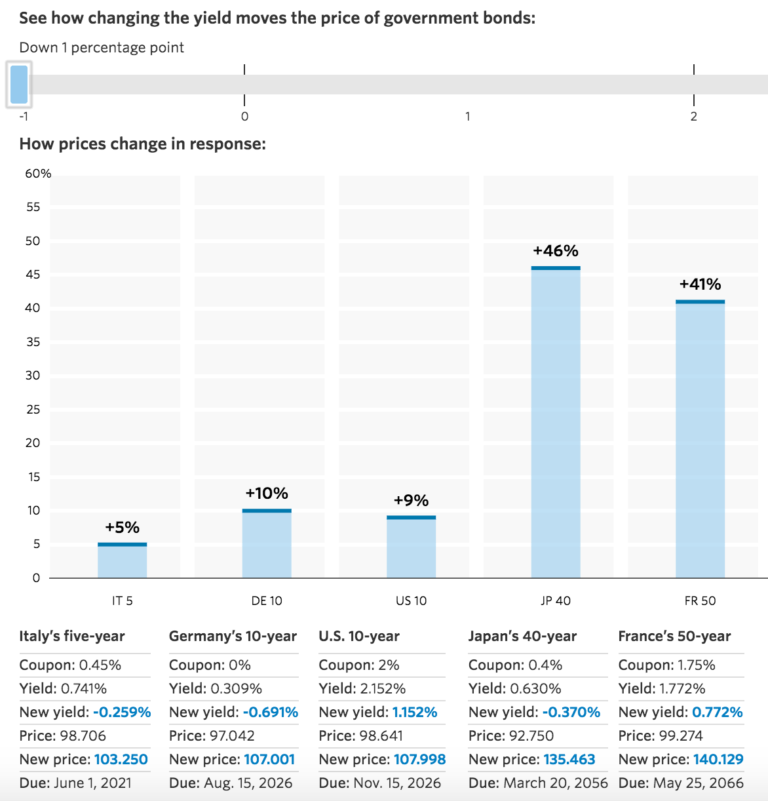
A Wealth of Common Sense – The Bright Side of Rising Interest Rates – Ben Carlson 11/13

Charts from the Wall Street Journal. Effect of a 1 percentage point increase:

wsj_effects-of-yield-change-increase-of-1-point_11-13-16

Effect of a 1 percentage point decrease:

wsj_effects-of-yield-change-decrease-of-1-point_11-13-16

Featured

*Note: bold emphasis is mine, italic sections are from the articles.

Era of Low Interest Rates Hammers Millions of Pensions Around World. Timothy W. Martin, Georgi Kantchev, and Kosaku Narioka. Wall Street Journal. 13 Nov. 2016.

“As low interest rates suppress investment gains in the pension plans, it generally means one thing: Standards of living for workers and retirees are decreasing, not increasing.”

“The low rates exacerbate cash problems already bedeviling the world’s pension funds. Decades of underfunding, benefit overpromises, government austerity measures and two recessions have left many retirement systems with deep funding holes. A wave of retirees world-wide is leaving fewer active workers left to contribute. The 60-and-older demographic is expected to roughly double between now and 2050, according to the United Nations.”

“Pension funds around the world pay benefits through a combination of investment gains and contributions from employers and workers. To ensure enough is saved, plans adopt long-term annual return assumptions to project how much of their costs will be paid from earnings. They range from as low as government bond yield in much of Europe and Asia to 8% or more in the U.S.”

“The problem is that investment-grade bonds that once churned out 7.5% a year are now barely yielding anything. Global pensions on average have roughly 30% of their money in bonds.”

“Funding gaps for the two biggest funds in Europe and the U.S. have ballooned by $300 billion since 2008, according to a Wall Street Journal analysis.”

“Japan is wrestling with the same question of generational inequality. Roughly one-quarter of its 127 million residents are now old enough to collect a pension. More than one-third will be by 2035.”

wsj_pension-pressure_11-13-16

“A typical Japanese couple who are both 65 would collect today a monthly pensions of ¥218,000 ($2,048). If they live to their early 90s, those payouts, adjusted for inflation, would drop 12% to ¥192,000.”

“In the U.S., the country’s largest public-pension plan is struggling with the same bleak outlook. The California Public Employees’ Retirement System, which handles benefits for 1.8 million members, recently posted a 0.6% return for its 2016 fiscal year, its worst annual result since the financial crisis. Its investment consultant recently estimated that annual returns will be closer to 6% over the next decade, shy of its 7.5% annual target.”

“Yet the Sacramento-based plan still has just 68% of the money needed to meet future retirement obligations. That means cash-strapped cities and counties that make annual payments to Calpers could be forced to pay more.”

As an example, the affluent city of Costa Mesa in Orange County, “has outsourced government services such as park maintenance, street sweeping and the jail, as a way to absorb higher payments to Calpers. Pension payments currently consumer about $20 million of the $100 million annual budget, but are expected to rise to $40 million in five years.”

“The outsourcing and other moves eliminated one-quarter of the city’s workers. The cost of benefits for those remaining will surge to 81 cents of every salary dollar by 2023, from 37 cents in 2013, according to city officials.

Pollution in India: Worse than Beijing. Economist. 10 Nov. 2016.

“Delhi’s annual average measure of PM2.5, a fine dust that is the most toxic component of its pollution, stands at 122 micrograms per cubic meter (μg/m3), about double Beijing’s annual average. On Diwali and ten succeeding days this year, Delhi’s air was clogged with averages of well over 500μg/m3, with peaks of up to 1,000μg/m3. The World Health Organization (WHO) says the ‘safe’ PM2.5 level is a mere 25μg/m3 over hours.”

“Edward Avol, an American scientist who has studied the effects of vehicle exhaust on children, says that Delhi’s pollution is at ‘an occupational level of exposure,’ meaning that it is as bad as that experienced by, say, miners using power tools in a closed space.”

Why… a couple of reasons. 1) The burning of rice stubble after harvest in neighboring areas – politicians are loath to make life difficult for farmers and have provided subsidies to encourage rice cultivation over other crops. 2) The diesel fuel used in India – which has also been subsidized to make it cheaper for farmers and truck drivers whose rigs and machinery run on diesel. Side effect is that diesel has been cheaper than gasoline, hence most Indians drive vehicles that run on diesel. 3) There are simply a lot of people in Delhi and the country is going through an industrialization.

As to the price being paid by the citizens… “A study published in Delhi in 2008 estimated that 40% of residents had damaged lungs. Along with a range of other ill effects from pollution, they were five times more likely to suffer from chronic lung disease than other Indians, and four times more likely to have hypertension.”

“Frighteningly, notes Mr. Avol, those results were based on levels of pollution that are only one-fifth to one-tenth of what Delhi lives with.”

In Trump’s China, Industrial Subsidies Loom Large. Anjani Trivedi. Wall Street Journal. 16 Nov. 2016.

“Large government subsidies, which are no secret, are becoming a larger part of operating profits at China’s companies, both state-owned and private. Almost 14% of listed, nonfinancial companies’ profits are attributable to government support, according to an analysis by Wind Info. That’s up from just under 5% six years ago. Even among private firms, many of which have state shareholders, 11% of profits come from the state.”

“Driving the need for the hand outs: In China, when a company posts losses for four straight years, it gets delisted from the stock exchange. Almost 10% of listed provincial state-owned companies rely on government largess to be profitable.”

wsj-chinese-industrial-subsidies_11-16-16

“Thriving sectors benefit as well. In China’s car industry, the world’s largest, subsidies have grown 50% annually since 2010. For leading car maker Geely, government subsidies and grants have accounted for 19% of gross profits, on average, over the past five years.”

However, “government incentives are hardly confined to China. The U.S. has its own web of tax incentives and other inducements. Global multinationals rank among the largest recipients too. Many boost come through programs that incentivize consumers. China’s help tends to be more on the supply-side.”

Other Interesting Articles

Bloomberg Businessweek

The Economist

Bloomberg – Manhattan Renters Score Record Incentives in Apartment Glut 11/10

Bloomberg – Oil, Earthquakes and the Rush to Save Oklahoma 11/14

Bloomberg – The Real Cost of an MBA 11/16

FT – India’s cash chaos sparks growing backlash 11/13

FT – Buy dollars is the sudden Trump-era consensus trade 11/13

FT – Oil demand will grow for decades, says IEA 11/15

FT – Inflating inflation expectations 11/16

FT – Italy’s 50-year bond burnt in global sell-off 11/16

FT – Bank of Japan tests new firepower 11/16

FT – China’s renminbi hits 8-year low 11/16

FT – US urged to ban acquisitions by Chinese state-owned companies 11/16

LinkedIn – Reflections on the Trump Presidency, One Week after the Election (Ray Dalio) 11/15

NYT – ‘We Couldn’t Believe Our Eyes’: A Lost World of Shipwrecks Is Found 11/11

NYT – Teslas in the Trailer Park: A California City Faces Its Housing Squeeze 11/13

WSJ – SolarCity Could Give Tesla Too Much Sun 11/13

WSJ – At Long Last: The Earnings Recession Is Finally Over 11/13

WSJ – China’s Jack of All Trades (Evergrande Group) Needs a New Strategy 11/15

WSJ – China’s Debt Plan Feels Like Bad Case of déjà vu 11/15

WSJ – Donald Trump: The Housing Market’s Latest Threat 11/15

WSJ – New Competition for ‘Co-Working’ Model 11/15

WSJ – Firms Flee Mortgage-Backed Bond Business 11/15

WSJ – Ritzy Rentals Flood the Market 11/16

WSJ – Bank of Japan Keeps Rates Ready for Something Bigger 11/17