

Folks this Pension issue is a BIG PROBLEM. Speaking of problems, pollution in Delhi is a doozy. Supply side subsidies loom large in corporate China.
Headlines
- Reuters – ‘Trump Thump’ whacks bond market for $1 trillion loss 11/14. Inflation expectations are up resulting in major bond losses.
- FT – Saudi Arabia warns Trump on blocking oil imports 11/15. Basically, check yourself before you wreck yourself.
- NYT – Biggest Spike in Traffic Deaths in 50 Years? Blame Apps 11/15. “In the first six months of 2016, highway deaths jumped 10.4%” and that’s up from last year which had the largest annual percentage increase in 50 years.
- JPMorgan Is Said to Settle Bribery Case Over Hiring in China 11/16. JPMorgan Chase is ponying up $264 million to put its hiring practices (one in which Chinese ‘princelings’ were targeted to gain access to their parents) behind it.
- FT – Twitter suspends accounts belonging to ‘alt-right’ members 11/16. This is going to be an interesting debate in the public sphere for some time…whether Twitter, Facebook, Snapchat, etc. are meant to be a public commons where all opinions are heard, or is it their responsibility/right to censor content?
- FT – Facebook finds fresh errors in ad measuring 11/16. So about those metrics I was using to base your fees on, well I overestimated them by about double…
Special Reports / Opinion Pieces
- GMO Quarterly Letter – Not With a Bang But A Whimper – Jeremy Grantham – Q3 2016
- “Well, the US market today is not a classic bubble, not even close. The market is unlikely to go “bang” in the way those (Japanese land and Japanese equities in 1989, US tech in 2000, and more or less everything in 2007) bubbles did. It is far more likely that the mean reversion will be slow and incomplete. The consequences are dismal for investors: we are likely to limp into the setting sun with very low returns. For bubble historians, though, it is heartbreaking for there will be no histrionics, no chance of being a real hero. Not this time.”
Briefs
- Anjani Trivedi of the Wall Street Journal covered an interesting side effect on India’s bonds resulting from its initiative to remove Black-Money from circulation.
- While not the crux of the article, Anjani provides a succinct description of the rationale for Prime Minister Modi’s recent invalidation of 500 and 1,000-rupee notes (with just a few hours’ notice).
- “The shock reform is aimed at rubbing out India’s pervasive black money – or unaccounted-for cash, some counterfeit, some legitimate but evading taxes. It is a bold move for Prime Minister Narendra Modi, who should get credit for bringing a larger part of the shadow economy into the formal economy.”
- “But it is a dangerous move in the near term. The shadow economy accounts for more than 20% of gross domestic product and cash is equal to 12% of the GDP, triple the level in emerging markets generally, according to Nomura. The move has the potential to stifle commerce until the new notes are widely available.”
- Pilita Clark of the Financial Times discussed an interesting finding by Scientists that there is progress in the fight against growing CO2 emissions.
- “Global carbon dioxide emissions from burning fossil fuels have stayed almost flat for the third year in a row in what scientists say is a “clear and unpredicted break” that could mark a turning point in the world’s efforts to curb climate change.”
- “Emissions are only expected to rise by 0.2% in 2016, having failed to increase in 2015 and growing by just 0.7% in 2014.”
- “That is a sharp turnaround from the decade up to 2013 when carbon pollution growth averaged 2.3% a year.”
- “A fall in the use of coal in China, by far the world’s largest carbon emitter, is the main reason for the slowdown.”
- However, “researchers also cautioned that the job of curbing dangerous temperature rises had been made harder by the record growth of carbon dioxide concentrations in the atmosphere.”
- “Atmospheric CO2 levels surged to 400 parts per million in 2015, the highest level seen in at least the last 800,000 years.”
- “Concentrations are expected to climb to new records in 2016 on the back of a strong El Nino weather system that produced hot and dry conditions in many parts of the world, sapping the ability of trees and other vegetation to absorb carbon dioxide.”
- Lucy Hornby and Christian Shepherd of the Financial Times featured the lengths that Chinese shopping mall landlords are going through to attract visitors to their centers, steps that include housing a polar bear named ‘Pizza.’
- “The use of animals and other attractions comes as malls combat overcapacity, a problem immediately apparent to anyone who has turned up at a dusty, half-vacant shopping center in China’s provincial cities. The country has an estimated 4,000 malls, more than the US, and plans to reach 7,000 by 2025, according to Mall China, an industry organization.”
- “Malls are starting to bring in a lot more entertainment and a lot more food. There is also a big focus on children – playgrounds, learning centers, even museums.” – Shaun Rein, founder of Shanghai-based China Market Research Group
- “Last year 83 shopping malls gave up the fight and closed, according to a blue book on the commercial sector by the Chinese Academy of Social Sciences. They will be joined this year by Marks and Spencer, which announced last week it would close several stores in China in an effort to boost its flagging fortunes.”
- Landon Thomas Jr. of the New York Times highlighted a recent interview with Blackstone’s Hamilton E. James and his plans to help with the retirement crisis.
- The billionaire, Hamilton E. James, president of Blackstone, the private equity group. The plan, mandatory retirement contributions. It works in Singapore…
- Why… “the average retirement savings for Americans from the age of 40 to 55 is $14,500… Sixty-eight percent of working-age Americans do not have an employer-sponsored retirement plan. And by 2050, 25 million Americans are projected to face lives of poverty when they stop working.”
- Peter Grant of the Wall Street Journal pointed to the trouble brewing in commercial real estate.
- “Defaults are rising in a key corner of the commercial real-estate debt market just as borrowing costs are set to jump, raising the likelihood of a slowdown of the $11 trillion U.S. commercial property sector in 2017.”
- “Commercial property sales volume was down 8.6% in the first nine months of 2016 to $345.4 billion, according to Real Capital Analytics.”
- “Now defaults are on the rise as well. More than 5.6% of some $390 billion worth of commercial property mortgages that have been packaged into securities was more than 60 days late in payment in September, according to Moody’s Investors Service. That was up from a 4.6% delinquency rate earlier this year.”
- “In all, Morningstar Credit Ratings LLC predicts borrowers won’t be able to pay off roughly 40% of the commercial mortgage-backed securities loans coming due next year.”
- “Adding to the market’s worries are new rules that go into effect on Christmas Eve under the Dodd-Frank regulatory overhaul requiring issuers of commercial mortgage-backed securities to keep at least 5% of the securities they create.”
- “The so-called risk-retention rules likely will make borrowing more costly and complicated, raising the chances that some property owners won’t be able to refinance loans from the boom years.”
- Chris Kirkham of the Wall Street Journal illustrated how a worker shortage has led more home builders to turn to prefab construction.
- “A persistent shortage of construction workers across the U.S. is prompting some of the nation’s largest home builders to experiment with a model they once derided: factory production.”
- “In the U.S., only about 2% to 3% of homes built in recent years are classified as modular, according to the Census. In other parts of the world, that share is significantly higher. More than a third of all homes in Austria and Sweden are built using off-site methods, and in Japan more than three-quarters of all detached homes are pre-assembled, according to industry research.”

- “But throughout the U.S. housing recovery, builders have suffered from a shortage of skilled labor, making it tough for them to keep up with demand. The number of workers employed in the industry this year is nearly 30% below the peak in 2006 and more than 15% below the average during the 2000s, according to the Labor Department.”
- Chris Kirkham of the Wall Street Journal featured a recent affordable-housing initiative that was passed in Los Angeles that builders say will stifle construction.
- “Nearly two-thirds of Los Angeles voters last week approved a citywide affordable-housing requirement for developers seeking to build projects of 10 or more units that need a zoning or height change.”
- “The rule requires that up to 25% of units in rental properties and up to 40% in for-sale projects meet affordability guidelines. Alternatively, developers can pay a fee to the city.”
- On top of that, the Los Angeles initiative “sets wage standards for the projects.”
- “Developers must pay construction wages on par with those required for public-works projects, hire 30% of the workforce from within city limits, set aside 10% of jobs for certain disadvantaged workers living within 5 miles of the project and ensure 60% of workers have experience on par with graduates of a union apprenticeship program.”
- Yeah, so that shortage in labor mentioned above is only going to get better when the qualifications and attributes of which labor you can use are made specific.
- “Research is mixed on whether affordable housing mandates restrict the overall supply of housing in an area. A San Jose University study of California cities adopting such requirements in the mid-2000s found a notable decline in building permits after the rules were put in place, whereas other studies have found little or no effect on overall construction.”

Graphics
Bloomberg – World’s Biggest Real Estate Binge Is Coming to a City Near You 11/14

FT – India’s cash clampdown is not radical enough – Martin Sandbu 11/14

FT – 10-yr Bund yields at 9-month high as bond sell-off continues – Nicholas Megaw 11/13

WSJ – Daily Shot Charts – 11/15


A Wealth of Common Sense – The Bright Side of Rising Interest Rates – Ben Carlson 11/13
Charts from the Wall Street Journal. Effect of a 1 percentage point increase:

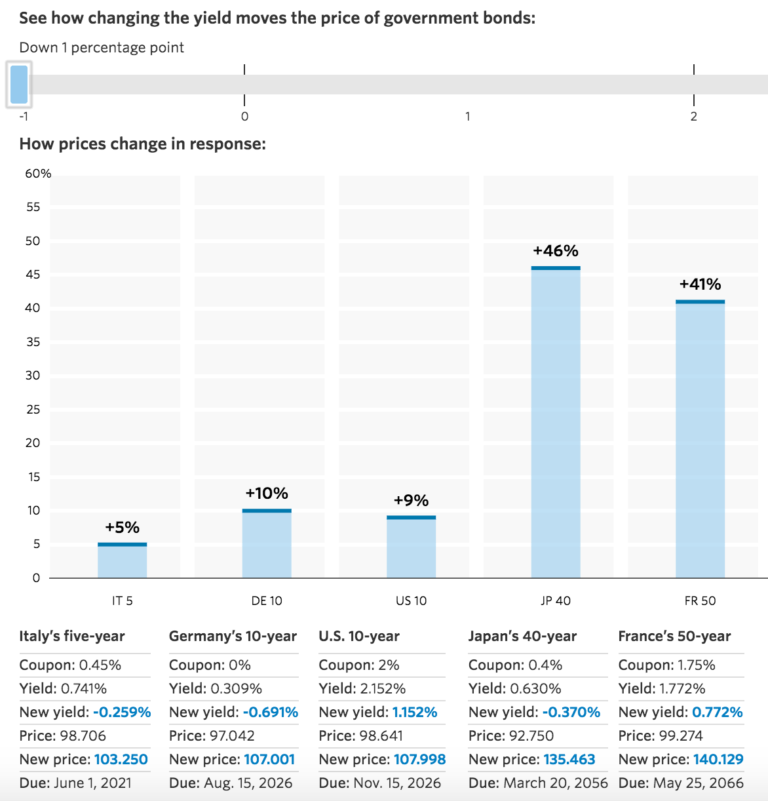
Effect of a 1 percentage point decrease:
Featured
*Note: bold emphasis is mine, italic sections are from the articles.
Era of Low Interest Rates Hammers Millions of Pensions Around World. Timothy W. Martin, Georgi Kantchev, and Kosaku Narioka. Wall Street Journal. 13 Nov. 2016.
“As low interest rates suppress investment gains in the pension plans, it generally means one thing: Standards of living for workers and retirees are decreasing, not increasing.”
“The low rates exacerbate cash problems already bedeviling the world’s pension funds. Decades of underfunding, benefit overpromises, government austerity measures and two recessions have left many retirement systems with deep funding holes. A wave of retirees world-wide is leaving fewer active workers left to contribute. The 60-and-older demographic is expected to roughly double between now and 2050, according to the United Nations.”
“Pension funds around the world pay benefits through a combination of investment gains and contributions from employers and workers. To ensure enough is saved, plans adopt long-term annual return assumptions to project how much of their costs will be paid from earnings. They range from as low as government bond yield in much of Europe and Asia to 8% or more in the U.S.”
“The problem is that investment-grade bonds that once churned out 7.5% a year are now barely yielding anything. Global pensions on average have roughly 30% of their money in bonds.”
“Funding gaps for the two biggest funds in Europe and the U.S. have ballooned by $300 billion since 2008, according to a Wall Street Journal analysis.”
“Japan is wrestling with the same question of generational inequality. Roughly one-quarter of its 127 million residents are now old enough to collect a pension. More than one-third will be by 2035.”

“A typical Japanese couple who are both 65 would collect today a monthly pensions of ¥218,000 ($2,048). If they live to their early 90s, those payouts, adjusted for inflation, would drop 12% to ¥192,000.”
“In the U.S., the country’s largest public-pension plan is struggling with the same bleak outlook. The California Public Employees’ Retirement System, which handles benefits for 1.8 million members, recently posted a 0.6% return for its 2016 fiscal year, its worst annual result since the financial crisis. Its investment consultant recently estimated that annual returns will be closer to 6% over the next decade, shy of its 7.5% annual target.”
“Yet the Sacramento-based plan still has just 68% of the money needed to meet future retirement obligations. That means cash-strapped cities and counties that make annual payments to Calpers could be forced to pay more.”
As an example, the affluent city of Costa Mesa in Orange County, “has outsourced government services such as park maintenance, street sweeping and the jail, as a way to absorb higher payments to Calpers. Pension payments currently consumer about $20 million of the $100 million annual budget, but are expected to rise to $40 million in five years.”
“The outsourcing and other moves eliminated one-quarter of the city’s workers. The cost of benefits for those remaining will surge to 81 cents of every salary dollar by 2023, from 37 cents in 2013, according to city officials.“
Pollution in India: Worse than Beijing. Economist. 10 Nov. 2016.
“Delhi’s annual average measure of PM2.5, a fine dust that is the most toxic component of its pollution, stands at 122 micrograms per cubic meter (μg/m3), about double Beijing’s annual average. On Diwali and ten succeeding days this year, Delhi’s air was clogged with averages of well over 500μg/m3, with peaks of up to 1,000μg/m3. The World Health Organization (WHO) says the ‘safe’ PM2.5 level is a mere 25μg/m3 over hours.”
“Edward Avol, an American scientist who has studied the effects of vehicle exhaust on children, says that Delhi’s pollution is at ‘an occupational level of exposure,’ meaning that it is as bad as that experienced by, say, miners using power tools in a closed space.”
Why… a couple of reasons. 1) The burning of rice stubble after harvest in neighboring areas – politicians are loath to make life difficult for farmers and have provided subsidies to encourage rice cultivation over other crops. 2) The diesel fuel used in India – which has also been subsidized to make it cheaper for farmers and truck drivers whose rigs and machinery run on diesel. Side effect is that diesel has been cheaper than gasoline, hence most Indians drive vehicles that run on diesel. 3) There are simply a lot of people in Delhi and the country is going through an industrialization.
As to the price being paid by the citizens… “A study published in Delhi in 2008 estimated that 40% of residents had damaged lungs. Along with a range of other ill effects from pollution, they were five times more likely to suffer from chronic lung disease than other Indians, and four times more likely to have hypertension.”
“Frighteningly, notes Mr. Avol, those results were based on levels of pollution that are only one-fifth to one-tenth of what Delhi lives with.”
In Trump’s China, Industrial Subsidies Loom Large. Anjani Trivedi. Wall Street Journal. 16 Nov. 2016.
“Large government subsidies, which are no secret, are becoming a larger part of operating profits at China’s companies, both state-owned and private. Almost 14% of listed, nonfinancial companies’ profits are attributable to government support, according to an analysis by Wind Info. That’s up from just under 5% six years ago. Even among private firms, many of which have state shareholders, 11% of profits come from the state.”
“Driving the need for the hand outs: In China, when a company posts losses for four straight years, it gets delisted from the stock exchange. Almost 10% of listed provincial state-owned companies rely on government largess to be profitable.”

“Thriving sectors benefit as well. In China’s car industry, the world’s largest, subsidies have grown 50% annually since 2010. For leading car maker Geely, government subsidies and grants have accounted for 19% of gross profits, on average, over the past five years.”
However, “government incentives are hardly confined to China. The U.S. has its own web of tax incentives and other inducements. Global multinationals rank among the largest recipients too. Many boost come through programs that incentivize consumers. China’s help tends to be more on the supply-side.”
Other Interesting Articles
Bloomberg Businessweek
- Is China Repeating Japan’s Missteps?
- Americans Are Dying Faster. Millennials, Too
- Nobody Knows Why Fortysomethings Are Driving U.S. Productivity
- The NFL Was a Sure Thing for TV Networks. Until Now
The Economist
- The Trump era
- Negotiating Brexit – The way forward
- Property in Venezuela – Maduro’s boom: Companies are turning cash into concrete as fast as they can
- Ferdinand Marcos – Hail to the thief
- Housing in America – The cost of poor lending: A city (Miami) seeks the right to sue banks for ‘irresponsible’ mortgage-lending
- The implications of this case are FAR reaching
- Housing in America – To those that have: Prices are diverging on geographic, social and ethnic lines
Bloomberg – Manhattan Renters Score Record Incentives in Apartment Glut 11/10
Bloomberg – Oil, Earthquakes and the Rush to Save Oklahoma 11/14
Bloomberg – The Real Cost of an MBA 11/16
FT – India’s cash chaos sparks growing backlash 11/13
FT – Buy dollars is the sudden Trump-era consensus trade 11/13
FT – Oil demand will grow for decades, says IEA 11/15
FT – Inflating inflation expectations 11/16
FT – Italy’s 50-year bond burnt in global sell-off 11/16
FT – Bank of Japan tests new firepower 11/16
FT – China’s renminbi hits 8-year low 11/16
FT – US urged to ban acquisitions by Chinese state-owned companies 11/16
LinkedIn – Reflections on the Trump Presidency, One Week after the Election (Ray Dalio) 11/15
NYT – ‘We Couldn’t Believe Our Eyes’: A Lost World of Shipwrecks Is Found 11/11
NYT – Teslas in the Trailer Park: A California City Faces Its Housing Squeeze 11/13
WSJ – SolarCity Could Give Tesla Too Much Sun 11/13
WSJ – At Long Last: The Earnings Recession Is Finally Over 11/13
WSJ – China’s Jack of All Trades (Evergrande Group) Needs a New Strategy 11/15
WSJ – China’s Debt Plan Feels Like Bad Case of déjà vu 11/15
WSJ – Donald Trump: The Housing Market’s Latest Threat 11/15
WSJ – New Competition for ‘Co-Working’ Model 11/15
WSJ – Firms Flee Mortgage-Backed Bond Business 11/15
WSJ – Ritzy Rentals Flood the Market 11/16
WSJ – Bank of Japan Keeps Rates Ready for Something Bigger 11/17